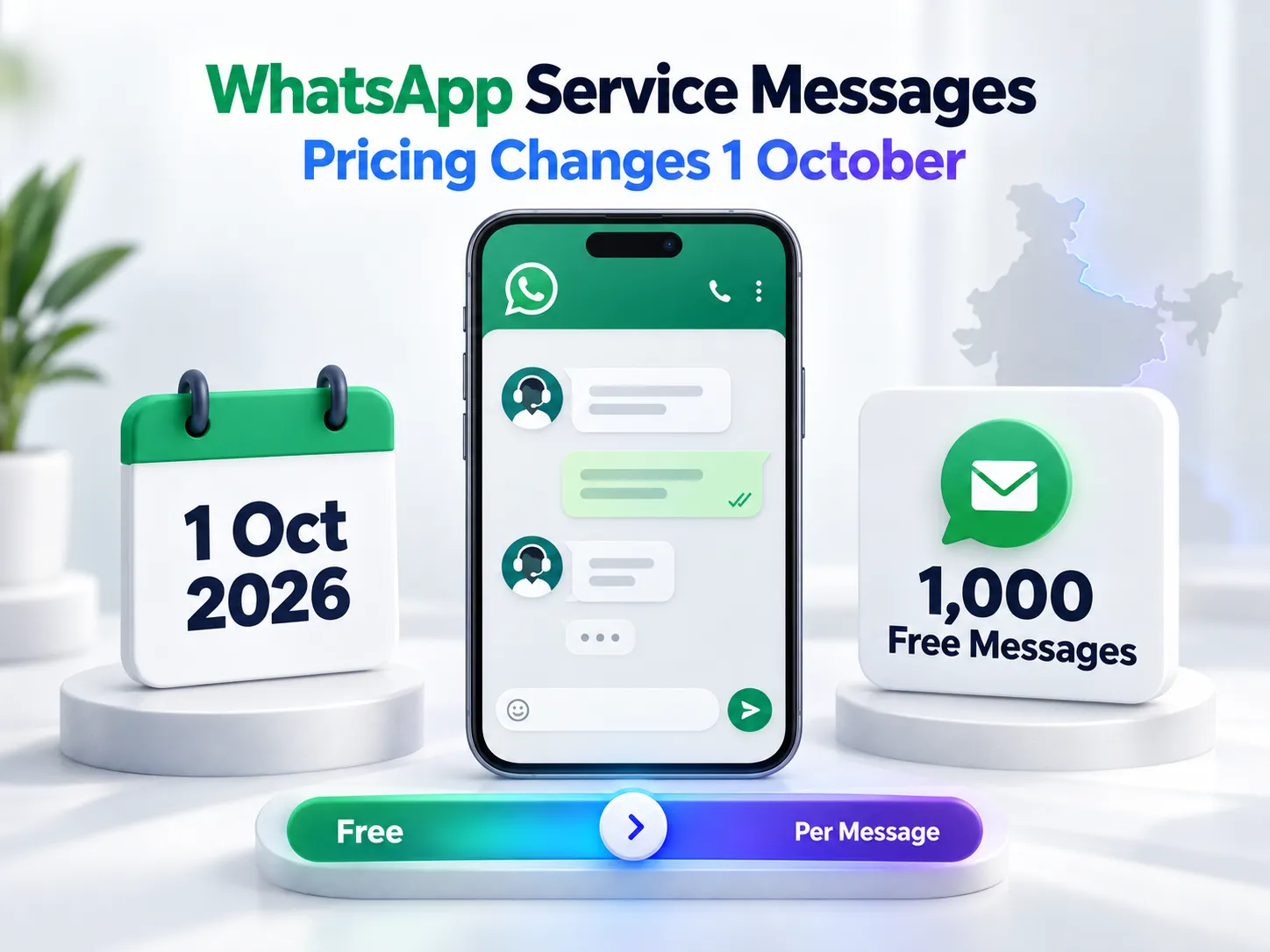
Responding to a customer through the WhatsApp Business Platform will no longer always be free.
From 1 October 2026, Meta will charge businesses for delivered service messages. These are non-template replies sent by a person, customer-service representative or third-party AI system while a customer’s 24-hour service window is open.
The change applies to businesses using the WhatsApp Business Platform directly or through a solution provider. It does not mean every WhatsApp message will carry the same charge, and it does not change the pricing of the standard WhatsApp Business app.
Meta originally announced the service-message pricing change on 1 July 2026. Its detailed notice was updated on 25 August, and the rates taking effect on 1 October were published on 1 September 2026. Meta for Developers: Upcoming pricing updates
Key takeaways
- Service messages become chargeable on 1 October 2026.
- Meta charges only when a business message is delivered, not merely sent.
- Service messages are charged per message.
- The rate depends on the recipient’s market.
- Service-message rates will match the applicable utility and authentication rates for that market.
- Meta will provide 1,000 free service messages per month for each business phone number.
- Service messages do not receive volume-tier discounts.
- The 24-hour customer-service window remains, but it no longer automatically makes every reply free.
- Eligible messages sent during a 72-hour free-entry-point window remain free for message delivery.
- Businesses without an accepted payment method may have service-message delivery stopped from 1 October.
- Messaging providers may charge separate platform, inbox, automation or support fees.
- The update does not guarantee better support performance or lower customer-service costs.
What exactly is changing?
Until 30 September 2026, service messages sent inside an open 24-hour customer-service window are not charged by Meta.
Starting on 1 October, Meta will charge for each delivered service message, subject to the applicable free-message rules. This brings service messages into the same per-message billing structure used for WhatsApp template categories.
Meta says service-message rates will be the same as utility and authentication rates for the recipient’s market. Unlike utility and authentication messages, service messages will not qualify for volume-tier discounts. Meta for Developers: Non-template message pricing
Before and after 1 October 2026
| Area | Until 30 September 2026 | From 1 October 2026 |
|---|---|---|
| Service-message delivery | Not charged by Meta | Charged per delivered message |
| Customer-service window | Open for 24 hours after each customer message | Continues to operate |
| Service-message rate | No Meta delivery charge | Same market rate as utility and authentication |
| Monthly free tier | Not required because service messages are free | 1,000 free service messages per business phone number |
| Volume discount | Not applicable | No volume tiers for service messages |
| Payment method | May not have been required for free replies | Required to prevent service-message disruption |
| 72-hour free entry point | Eligible message delivery is free | Remains free for eligible message delivery |
What is a WhatsApp service message?
A service message is a non-template response sent after a customer messages a business.
The customer’s message opens a 24-hour customer-service window. Each new message from the customer resets that window. During the open window, a business can send non-template replies.
A service message can be written or triggered by:
- A customer-support employee
- A sales representative
- A shared team inbox
- A rule-based chatbot
- A third-party AI support system
- A CRM or helpdesk integration
If a non-template reply is powered by Meta Business Agent, Meta classifies and prices it as a Meta Business Agent message instead of a service message. Meta states that only one message-category charge applies to a message. Meta for Developers: Upcoming pricing updates
Does the 24-hour service window still make replies free?
No. This is the part businesses are most likely to misunderstand.
The 24-hour window will continue to determine when non-template replies can be sent. From 1 October, it will no longer automatically remove the Meta delivery charge.
The new distinction is:
- 24-hour customer-service window: Determines whether a business can send non-template replies.
- Service-message pricing: Determines whether each delivered business reply is chargeable.
- Monthly free tier: Provides 1,000 free service messages per business phone number.
- 72-hour free-entry-point window: Can make eligible message delivery free when the customer enters through a qualifying Click-to-WhatsApp ad or Facebook Page call-to-action button.
Outside an open 24-hour customer-service window, businesses generally need an approved template message to contact the customer.
How the 1,000-message free tier works
Meta has announced a free monthly allowance of 1,000 service messages for each business phone number.
This is important for smaller Indian businesses. A company with one WhatsApp number and relatively few support conversations may remain within the allowance. A business with several active numbers receives a separate allowance for each number.
The allowance is based on messages, not complete conversations or customers. Several replies sent during one customer conversation can therefore use several free messages.
Meta’s pricing page states that the free tier applies per business phone number. Businesses should still confirm how the allowance and charges appear inside their own account or provider invoice. Meta for Developers: WhatsApp Business Platform pricing
Does the change apply in India?
Yes. Meta’s pricing system includes India as a recipient market and publishes INR rate cards.
The exact Meta charge depends on the recipient’s market and message category. Service messages sent to Indian WhatsApp users will use the applicable Indian utility and authentication message rate from 1 October 2026.
Businesses should check the official INR rate card before preparing a budget. They should not rely on an old quotation, a rate quoted for another country or a provider’s promotional price.
The final amount billed can also include:
- GST or other applicable taxes
- Business solution provider fees
- Shared-team-inbox charges
- Monthly software licences
- Chatbot or AI usage charges
- CRM integration costs
- Implementation and support fees
Meta’s rate is therefore only one part of the total WhatsApp Business Platform cost.
The payment-method deadline
Businesses using the Platform directly, as well as solution providers managing accounts, should confirm that every relevant WhatsApp Business Account has an accepted payment method.
Meta states that service messages may stop being delivered from 1 October 2026 if a payment method is not on file by 30 September. Meta for Developers: Service-message billing requirement
Businesses should verify:
- Which organisation owns the WhatsApp Business Account
- Who controls its billing settings
- Whether a payment method has been added
- Whether the payment method is active
- Which currency is used
- Whether the provider handles Meta charges directly
- How provider fees and Meta charges appear on invoices
- Who receives billing-failure notifications
Do not assume the agency, chatbot company or inbox provider has completed the billing setup. Ask for written confirmation.
The 72-hour free-entry-point exception
Meta’s existing free-entry-point rule remains available.
When a customer starts a conversation through an eligible Click-to-WhatsApp advertisement or Facebook Page call-to-action button, a 72-hour free-entry-point window can open. During that period, Meta does not charge for the delivery of eligible marketing, utility, authentication or service messages.
The customer must initiate the conversation through the qualifying entry point. A normal organic WhatsApp message does not automatically create the same 72-hour benefit.
Meta Business Agent token usage can still be charged even when message delivery is covered by the free-entry-point window. Meta for Developers: WhatsApp pricing rules
How the change may affect Indian businesses
Real estate agencies
Suppose a buyer messages an agency about a 2BHK property. The agent replies with the price, location, video, available visit times and a follow-up question.
From 1 October, each delivered business reply can count as a separate service message after the applicable free allowance or free-entry-point benefit has been considered.
This does not mean agents should send one long, confusing message. They should remove unnecessary fragments and organise useful details clearly.
A practical first reply could include:
- Property configuration
- Locality
- Asking price
- Carpet area
- Main features
- One clear qualifying question
- One next step
Clinics and appointment-based businesses
A clinic may receive questions about consultation timings, available doctors, fees and appointment changes.
It should separate conversational replies from utility templates such as confirmed appointment reminders. The clinic should also check how many messages are sent by employees, automated flows and third-party systems during each enquiry.
Retail and e-commerce businesses
Questions about sizes, delivery, returns and product availability commonly create multi-message conversations.
Businesses should review whether their chatbot asks too many questions before offering a useful answer. Order confirmations and shipping notifications may fall under the utility category, while free-form support replies inside the 24-hour window may be service messages.
Education and coaching businesses
A course enquiry can involve fees, batch timings, eligibility, location and counselling.
A structured WhatsApp Flow or concise first response may collect the required details with fewer separate messages. The objective should be clearer communication, not simply reducing the number of replies.
Restaurants, salons and local services
Small businesses may remain within the 1,000-message monthly allowance, but they should measure usage before assuming there will be no cost.
A salon using several automated reminders, staff replies and follow-up questions can cross the allowance faster than expected, especially if each sentence is sent as a separate message.
The Vertex Social R.E.P.L.Y. review
The following framework is a practical Vertex Social recommendation, not an official Meta framework.
R: Record current message volume
Use the WhatsApp pricing analytics available through the Platform or request data from the solution provider.
Record:
- Delivered service messages
- Business phone number
- Recipient country
- Conversation entry point
- Agent or automation source
- Customer-service outcome
- Provider charges
Meta’s Pricing Analytics API supports the SERVICE category, and delivery webhooks can show whether a service message is billable. Meta for Developers: Pricing Analytics
E: Examine the customer journey
Map what happens after a customer sends the first message.
Check:
- How quickly the first useful answer is sent
- How many separate business replies follow
- Which questions are repeated
- Whether the bot and employee request the same details
- Whether a lead is transferred between several people
- Whether conversations continue without a clear next action
P: Prepare the billing setup
Confirm the payment method before 30 September. Check the official INR rate card and obtain a complete provider quotation.
A proper quotation should separate:
- Meta message charges
- Provider licence or platform fees
- Team-user charges
- Automation charges
- AI charges
- Setup fees
- Taxes
L: Limit waste, not useful support
Do not reduce messages so aggressively that the customer receives incomplete or confusing answers.
Instead:
- Combine closely related information
- Remove duplicate automated replies
- Avoid sending one sentence as several messages
- Use forms or Flows for structured data collection
- Route the enquiry to the right employee
- Stop automation after a live agent takes over
- Close abandoned internal workflows
Y: Yield to measurement
Track business results alongside message costs:
- Cost per customer enquiry
- Cost per resolved support case
- Cost per qualified lead
- First-response time
- Resolution time
- Chatbot handoff rate
- Appointment or site-visit bookings
- Customer opt-outs
- Sales-team feedback
A lower message count does not automatically mean a better customer experience. The aim is to remove waste while protecting response quality.
What businesses should do before 1 October
- Confirm who owns and manages the WhatsApp Business Account.
- Add or verify the required payment method by 30 September.
- Download current service-message volumes by phone number.
- Check whether each number will exceed the 1,000-message allowance.
- Review the official INR rate card.
- Request a complete cost breakdown from the solution provider.
- Separate service, utility, authentication and marketing messages.
- Identify conversations entering through eligible free entry points.
- Remove duplicate chatbot and employee responses.
- Test delivery, billing data and webhook classification.
- Set a monthly monitoring process.
- Keep a support plan ready if billing or message delivery fails.
What businesses should avoid
- Do not say the WhatsApp Business app is becoming paid.
- Do not describe the entire 24-hour window as free after 1 October.
- Do not treat one conversation as one charge.
- Do not assume every customer reply creates a 72-hour free window.
- Do not use a foreign-market rate to estimate Indian costs.
- Do not rely on a provider quotation that excludes Meta charges or taxes.
- Do not assume service messages receive volume discounts.
- Do not delay payment setup until the final day.
- Do not shorten support replies until they become unclear.
- Do not combine promotional outreach with customer-service replies without checking category and policy requirements.
- Do not claim that automation will automatically reduce costs.
- Do not assume the pricing change guarantees better support, leads or sales.
What remains uncertain for an individual business?
Meta has confirmed the charging model, free tier, payment deadline and effective date. The final impact on an individual Indian business cannot be calculated without account-level information.
The following will vary:
- Monthly service-message volume
- Number of business phone numbers
- Recipient markets
- Use of free entry points
- Provider fees
- Taxes
- Chatbot or third-party AI charges
- Existing contracts
- Billing currency
- Customer-response patterns
- Number of messages used to resolve each enquiry
Businesses should calculate the effect using their own delivered-message data, not a general estimate.
WhatsApp’s public marketing pricing page may continue to describe service messages as free before the effective date. The future pricing notice and October rate card are the relevant official sources for the upcoming change.
Frequently asked questions
When will WhatsApp service messages become chargeable?
Meta will begin charging for delivered service messages on 1 October 2026, based on the WhatsApp Business Account’s timezone.
What is the original announcement date?
Meta states that the service-message pricing change was announced on 1 July 2026. Detailed rates were published on 1 September 2026.
Are service messages currently free?
Yes. They remain free under the current Meta delivery-pricing rules until 30 September 2026.
Will every service message be charged?
Meta has announced 1,000 free service messages per month for each business phone number. Eligible service messages sent during a 72-hour free-entry-point window also remain free for delivery.
Is the 24-hour customer-service window being removed?
No. The window still controls when non-template replies can be sent. The replies sent within it become chargeable under the new rules.
Does the change apply to the WhatsApp Business app?
The announcement concerns the WhatsApp Business Platform. It should not be presented as a general charge for messages sent through the standard WhatsApp Business app.
What is the service-message rate in India?
Meta says the service rate will match the applicable utility and authentication rate for the recipient’s market. Businesses should check the official INR rate card because rates can change and provider fees may be added.
Can a business receive volume discounts?
Meta says it will not offer volume tiers for service messages. Utility and authentication messages can continue to qualify for their applicable volume tiers.
What happens if no payment method is added?
Meta says it will stop delivering service messages for affected solution providers or directly integrated businesses without a payment method when charging begins.
Are customer messages charged?
Meta’s announcement concerns messages delivered from businesses to WhatsApp users. Customer messages to a business are not described as chargeable service messages.
What Indian businesses should do now
The main risk is not simply an increased bill. A missing payment method could interrupt customer replies, while an inefficient chatbot or team workflow could create avoidable per-message charges.
Start with actual delivery data. Confirm billing, review how messages are classified and identify where customers receive repeated or unnecessary replies. Preserve useful communication while simplifying the journey.
Vertex Social can review an existing WhatsApp Business Platform setup, including team routing, automation, message categories and enquiry handling, before the new pricing takes effect.