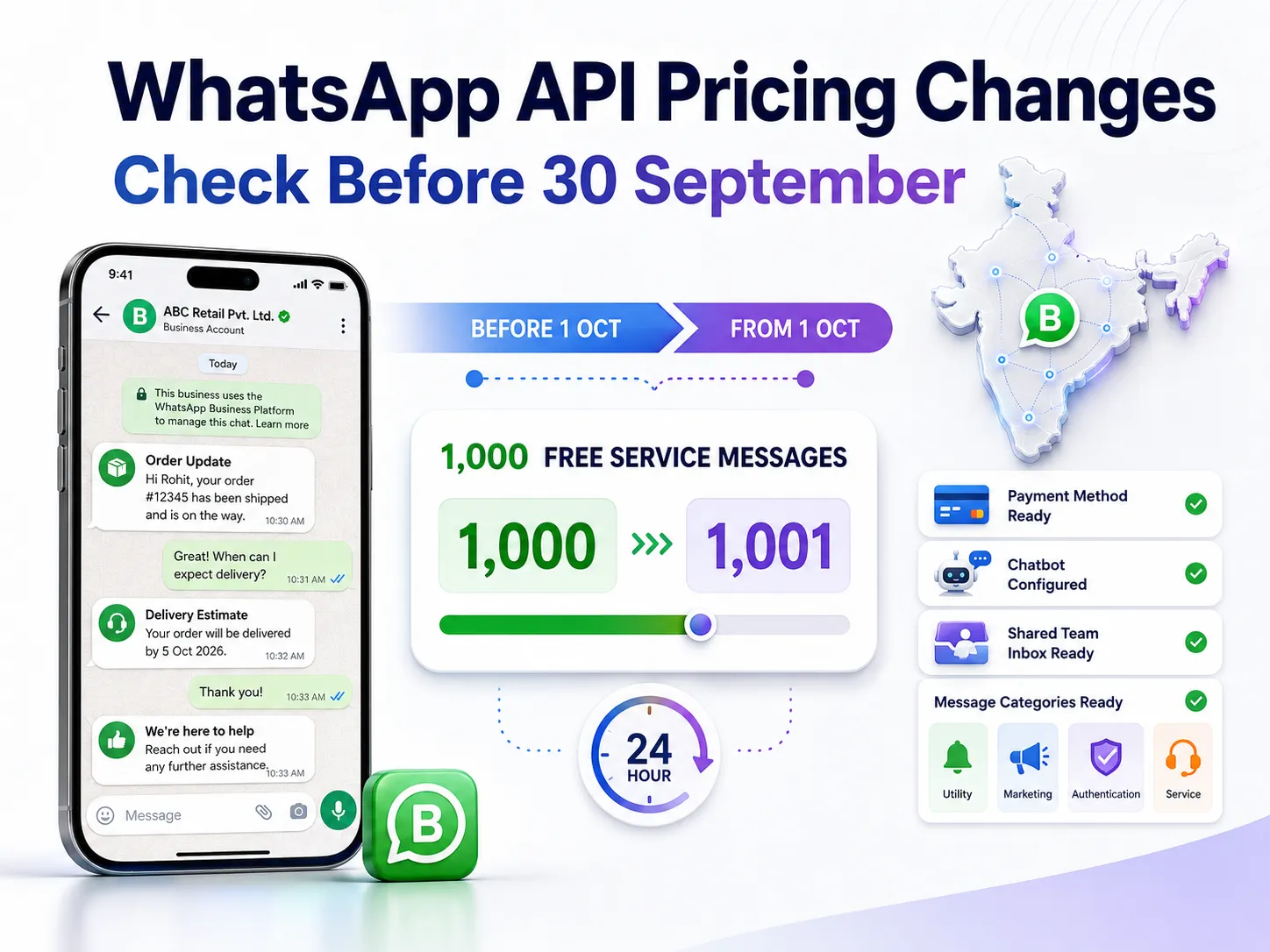
Meta is changing how service and utility messages are charged on the WhatsApp Business Platform from 1 October 2026.
The change does not mean personal WhatsApp is becoming paid. It also does not introduce per-message charges for ordinary manual replies sent through the free WhatsApp Business app.
It applies to messages delivered through the WhatsApp Business Platform, commonly called the WhatsApp Business API or Cloud API. This includes messages sent through shared team inboxes, customer-support dashboards, CRM integrations, chatbots and automation systems.
From October, every business phone number will receive 1,000 free service messages each month. Meta will begin charging from the 1,001st delivered service message. Utility templates sent during an open 24-hour customer-service window will also become chargeable and do not share this service-message allowance. Meta’s official pricing documentation
For Indian businesses already using the API, this is both a cost and continuity issue. Teams should understand their message categories, review recent volumes, confirm their billing arrangement and remove unnecessary automated replies before the new pricing begins.
Key takeaways for Indian businesses
- The change applies to the WhatsApp Business Platform/API.
- Personal WhatsApp and ordinary manual messaging through the free WhatsApp Business app are not affected.
- Service messages become chargeable from 1 October 2026.
- Each business phone number receives 1,000 free service messages monthly.
- Charging starts with the 1,001st delivered service message.
- Unused service-message allowances do not roll over.
- Utility templates sent inside the 24-hour customer-service window also become chargeable.
- Incoming customer messages are not charged by Meta.
- The 24-hour customer-service window is not being removed.
- Eligible 72-hour free-entry-point messaging remains available under Meta’s conditions.
- Meta charges for delivered messages, not merely attempted sends.
- Business Solution Provider subscriptions, markups and taxes may be additional.
- Affected directly integrated businesses and Solution Providers should confirm that an appropriate payment method is on file by 30 September 2026.
- Indian businesses should verify the live Meta rate card instead of relying on an old or rounded rupee figure.
What exactly is changing on 1 October 2026?
Two important message types that are currently free in particular situations will become chargeable.
Service messages become chargeable
A service message is generally a non-template response sent by a business while the 24-hour customer-service window is open.
The window begins when a customer messages the business and resets when the customer sends another message. During this period, a business can respond using non-template messages through a human agent, chatbot or third-party automation.
These service messages have not been charged since 1 November 2024. From 1 October 2026, Meta will charge for delivered service messages after the free monthly allowance is used. Meta’s service and non-template pricing update
In-window utility templates become chargeable
Utility templates communicate genuine non-promotional information connected to a customer action or transaction. Examples may include an order update, appointment reminder, account notification or payment confirmation, provided the content meets Meta’s utility-category rules.
Utility templates sent inside an open customer-service window have been free since 1 July 2025. From 1 October 2026, these messages will again be charged per delivered message.
The 1,000-message allowance is specifically for service messages. Businesses should not assume that their utility, authentication or marketing messages are included.
WhatsApp pricing before and after 1 October
| Message type | Through 30 September 2026 | From 1 October 2026 |
|---|---|---|
| Incoming customer message | Not charged by Meta | Not charged by Meta |
| Service reply within the 24-hour window | Free | First 1,000 per business phone number monthly are free; subsequent delivered messages are charged |
| Utility template within the 24-hour window | Free | Charged per delivered message |
| Utility template outside the window | Charged | Charged |
| Marketing template | Charged | Charged |
| Authentication template | Charged | Charged |
| Meta Business Agent response | Separate token-based pricing from 1 August 2026 | Separate token-based pricing continues |
| Eligible 72-hour free-entry-point delivery | Free under applicable conditions | Remains available under applicable conditions |
Meta’s public pricing overview confirms that WhatsApp Business Platform billing is based on delivered messages, their category and the recipient’s market. It recognises four core categories: marketing, utility, authentication and service. WhatsApp Business Platform pricing overview
Does this affect the free WhatsApp Business app?
No. This pricing change concerns the WhatsApp Business Platform/API.
The distinction is important:
| Product | Typical use | Affected by this API pricing change? |
|---|---|---|
| Personal WhatsApp | Individual conversations | No |
| WhatsApp Business app | Small-business messaging managed directly through the app | No per-message API charge introduced by this update |
| WhatsApp Business Platform/API | Shared inboxes, CRM systems, automation, chatbots and larger support operations | Yes |
| Third-party WhatsApp platform | Software built on or connected to the official API | Usually affected according to its Meta and provider billing structure |
A small shop manually answering customers through the WhatsApp Business app is not in the same billing setup as a real-estate company using an official API inbox for twenty team members.
Businesses unsure which product they use should check whether they have a WhatsApp Business Account in Meta Business Manager, an API provider subscription, approved message templates, a shared inbox or a Cloud API integration.
How does the 1,000-message allowance work?
From 1 October, every business phone number receives 1,000 free service messages each month.
The important wording is service messages, not conversations.
The allowance is per business phone number
If a business uses one official API number, that number receives its own monthly allowance. The allowance should not be described as one shared total for every number in a company unless the live Meta documentation says so.
Businesses should not create unnecessary phone numbers merely to multiply free allowances. Additional numbers increase operational complexity and can fragment customer history, reporting and team responsibility.
Charging starts from the 1,001st service message
If a business number delivers 800 service messages during a month, all 800 remain within the allowance.
If it delivers 1,300 service messages, the first 1,000 fall within the free allowance and 300 become potentially billable at the applicable service-message rate.
Utility, marketing, authentication and Meta Business Agent messages should be calculated separately.
The allowance resets monthly
Unused free service messages do not roll over. A number that uses only 600 messages in one month does not carry the remaining 400 into the following month.
Meta charges delivered messages
WhatsApp Business Platform pricing is based on messages successfully delivered to users. A message that was attempted but not delivered should not be treated in the same way as a delivered billable message.
Businesses should therefore compare delivery-status data—not merely the number of send attempts.
Why several short replies may increase costs
The move to per-delivered-message pricing means support teams should pay attention to how many separate message bubbles they send.
Consider this response pattern:
- “Hello.”
- “Let me check.”
- “Yes, the property is available.”
- “Would you like to schedule a visit?”
These are four separate outgoing service messages.
A clearer reply might be:
“Hello. Yes, the property is currently available. Would you like the complete details or should I help you schedule a site visit?”
That response provides the same useful information in one organised message.
The goal is not to send uncomfortably long paragraphs or reduce genuine customer support. It is to remove unnecessary acknowledgements, duplicate automation and fragmented replies that create cost without improving the customer experience.
What will WhatsApp service messages cost in India?
Meta prices WhatsApp Business Platform messages according to the recipient’s market and message category. The applicable market is generally connected to the recipient’s country or calling code—not simply the location of the business’s office.
An exact rupee rate has deliberately not been quoted here because:
- Meta can update rate cards.
- Different categories can carry different prices.
- Volume tiers may apply to eligible utility and authentication messages.
- Service messages do not receive the same volume-tier treatment.
- A Business Solution Provider may add a subscription, platform fee or markup.
- GST or other billing treatment may be shown separately by the provider.
- Billing currency and account configuration can affect how charges appear.
Businesses should check the live India rate through Meta’s official WhatsApp pricing documentation and then confirm how their provider passes those charges through.
A rounded rate seen in an article, screenshot or sales message should not be treated as the complete monthly cost.
How to estimate your October WhatsApp cost
Start with message volumes rather than the total number of customer conversations.
Service-message calculation
Use this basic formula:
Potentially billable service messages = Monthly delivered service messages − 1,000 free messages
If the result is below zero, use zero.
Then:
Estimated Meta service cost = Potentially billable service messages × Live India service-message rate
Add other message categories separately
Estimate:
- Utility templates inside the service window
- Utility templates outside the service window
- Marketing templates
- Authentication templates
- Authentication-international messages, where relevant
- Meta Business Agent token usage, if used
Add provider-level costs
Your final bill may also contain:
- Monthly platform subscription
- Shared-inbox charges
- Charges per team member
- Automation or chatbot charges
- CRM integration charges
- Provider markup
- Support-plan charges
- Taxes
Ask the provider to distinguish Meta’s messaging charge from its own software and service fees.
What is the 24-hour customer-service window?
The 24-hour customer-service window opens when a customer sends a message to the business.
Another customer message resets the window. While it remains open, the business can send eligible non-template service replies.
The October pricing change does not remove this window. It changes the price of outgoing service messages delivered during it.
Outside the 24-hour window, a business generally needs an approved template to restart communication. It should not attempt to use non-template messages outside the permitted window.
Are click-to-WhatsApp conversations still free?
Meta says its 72-hour free-entry-point window remains unchanged for message delivery. This may apply when a customer begins a conversation through an eligible ad that clicks to WhatsApp or a Facebook Page call-to-action and the required conditions are met. Meta’s non-template message update
This does not mean every WhatsApp enquiry generated by an advertisement automatically receives free messaging.
The business must check:
- Whether the conversation came through an eligible entry point
- Whether the required response conditions were satisfied
- When the 72-hour period began
- Whether the message falls within that window
- Whether separate Meta Business Agent pricing applies
- How the provider displays free-entry-point messages in reporting
Businesses running click-to-WhatsApp Meta Ads management should verify the complete lead journey instead of assuming that every chat receives the exception.
Who needs to add a payment method before 30 September?
Meta’s documentation instructs directly integrated businesses and Solution Providers to have an appropriate payment method on file by 30 September 2026 to avoid possible disruption to service-message delivery when charging begins. Meta’s official update
However, not every business receives Meta charges through the same arrangement.
Some end clients pay their Business Solution Provider, which then manages or passes through Meta’s fees. Others may have billing linked more directly to their WhatsApp Business Account.
Every API user should ask:
- Who receives Meta’s message charges?
- Is Meta billing the business directly or through the provider?
- Is a valid payment method already attached?
- Which WhatsApp Business Accounts and phone numbers are covered?
- Are there credit, spending or wallet limits?
- What happens if the provider balance becomes insufficient?
- Which billing currency is being used?
- Are GST and provider fees shown separately?
Do not add or change payment details through a link received in an unsolicited message. Open Meta Business Manager or the verified provider dashboard directly.
Separate India billing-currency requirement
Meta’s pricing documentation also identifies a separate billing requirement for eligible Indian customers.
Affected customers must migrate applicable WhatsApp Business Accounts to INR by 31 December 2026 to avoid possible disruption from 1 January 2027. This is separate from the service-message pricing change and the 30 September payment-method preparation date.
Businesses should confirm eligibility and migration steps through Meta or their authorised provider rather than assuming that every Indian account requires the same action.
The Vertex Social WhatsApp Cost-Readiness Audit
Vertex Social recommends checking five areas before the October change.
1. Confirm which WhatsApp product you use
Determine whether the business uses:
- Personal WhatsApp
- The free WhatsApp Business app
- WhatsApp Cloud API
- A Business Solution Provider
- A shared team inbox
- A third-party chatbot
- A CRM integration
- Meta Business Agent
Only then can the business identify which pricing rules apply.
2. Review the previous 60–90 days
Export or examine messaging data for August and September.
Separate delivered outbound messages into:
- Service messages
- Utility templates
- Authentication templates
- Marketing templates
- Meta Business Agent responses
- Eligible free-entry-point messages
If the provider dashboard does not show these categories clearly, request a billing or delivery-status report.
3. Count message bubbles, not customer conversations
One customer conversation may contain many outgoing service messages. A team handling 500 enquiries could still send more than 1,000 service messages.
Review:
- Average outbound replies per enquiry
- Duplicate automated acknowledgements
- “Please wait” messages
- Repeated agent introductions
- Bot-to-agent handover messages
- Multiple reminders sent within the same interaction
- Replies created by both a bot and a human
4. Confirm billing continuity
Before 30 September, check:
- Payment method
- WABA billing status
- Provider wallet or credit
- Spending limits
- Billing currency
- Provider subscription
- Meta fee markup
- Tax treatment
- Account timezone
- Responsible billing contact
Record screenshots or download reports so the configuration can be checked later.
5. Improve the message flow safely
Remove messages that add no customer value, but do not weaken support simply to save a small amount.
Useful improvements may include:
- Combining related information into one clear response
- Removing duplicate greetings
- Preventing the bot and agent from answering simultaneously
- Using buttons for common next steps
- Showing availability, price and required documents together where appropriate
- Escalating complex enquiries to a person
- Preventing repeated reminders after a customer has responded
- Monitoring delivery and category classification
- Preserving consent and opt-out controls
A structured WhatsApp Business API setup and automation should make customer communication easier to follow—not simply send more messages.
Practical examples for Indian businesses
Real-estate business
A broker receives an enquiry from a click-to-WhatsApp advertisement. An automatic greeting is sent, followed by separate messages asking for location, budget, configuration and preferred visit time. A salesperson then repeats some of the same questions.
The business should check whether the automation can collect the information through a clearer structured flow and hand the complete requirement to the correct salesperson.
This does not mean removing personal follow-up. It means preventing the bot and sales team from duplicating each other.
Vertex Social’s Prime Square Realty WhatsApp campaign setup demonstrates the relevance of organised enquiry assignment, shared access and follow-up within a real-estate workflow.
Clinic or appointment-led business
A clinic may send an acknowledgement, appointment confirmation, doctor availability, payment instruction and reminder as separate messages.
Some of these may be service messages, while properly classified appointment notifications may be utility templates. The clinic should review the content and purpose of each message rather than selecting a category based on which one is cheaper.
E-commerce business
An online store may use marketing templates for offers, utility templates for order updates and service replies when customers ask about delivery or returns.
The store should calculate each category separately. The 1,000-message service allowance should not be applied to all order notifications.
Education or coaching business
A coaching institute may use WhatsApp to answer course enquiries, send fee confirmations and provide class reminders.
Promotional admission messages should not be disguised as utility updates. Category compliance remains important even when businesses are trying to manage costs.
Restaurant or local service business
A restaurant using only the free WhatsApp Business app for manual replies is not automatically affected by the API pricing change.
If the restaurant uses an API-connected ordering bot, team inbox or automated booking system, it should review that platform’s messaging and billing reports.
Should small businesses continue using WhatsApp Business API?
For many businesses, yes—provided the platform solves a genuine operational problem.
WhatsApp Business API can still be useful when a company needs:
- Multiple team members on one official number
- Enquiry assignment
- A shared customer history
- Automated qualification
- Chatbot flows
- CRM integration
- Approved outbound templates
- Reporting and monitoring
- Structured follow-ups
- Higher operational control
A business should compare the total cost with the value of faster responses, organised ownership and better enquiry management.
A company receiving only a small number of messages may remain within the monthly service allowance. A high-volume support operation may see a more noticeable cost. Neither outcome should be assumed without examining actual delivered-message data.
The October update is not a reason to abandon automation. It is a reason to make automation more intentional.
What businesses should avoid doing
Do not tell customers WhatsApp is becoming paid
The change does not introduce charges for personal WhatsApp users.
Do not assume every business reply is charged from the first message
Each business phone number receives 1,000 free service messages monthly. Other categories follow their own pricing rules.
Do not treat the allowance as 1,000 free conversations
Meta defines the allowance in service messages, not customer conversations.
Do not include utility messages in the service allowance
Utility templates are a separate category and become chargeable inside the customer-service window.
Do not misclassify promotions as utility messages
A message should be categorised according to its content and purpose—not according to the lower-cost category a business wants.
Do not optimise at the expense of customer experience
One clear message can be better than four fragmented replies. One confusing wall of text is not.
Do not rely only on attempted-message counts
Meta’s pricing is based on delivered messages. Review delivery statuses.
Do not assume the provider’s fee is Meta’s complete price
Separate Meta messaging charges from the provider’s subscription, software fees, markup and taxes.
Do not wait until 1 October to check billing
Billing or payment problems may take time to resolve. Complete the review before 30 September.
Do not add payment details through suspicious messages
Use Meta’s official business tools or the verified provider dashboard.
Frequently asked questions
Is WhatsApp becoming paid for everyone?
No. The change applies to messages delivered through the WhatsApp Business Platform/API. It does not make personal WhatsApp a paid messaging service.
Does it affect the free WhatsApp Business app?
The October API pricing change does not introduce per-message charges for ordinary manual messaging through the free WhatsApp Business app.
What is a WhatsApp service message?
It is a non-template business response sent during an open 24-hour customer-service window after a customer messages the business. It may be sent by a human agent, chatbot or third-party automation connected to the API.
Are customer messages charged?
Meta’s Platform pricing charges businesses for applicable messages delivered to users. Incoming customer messages are not billed as outbound business messages.
How many service messages remain free?
Each business phone number receives 1,000 free service messages per month. Charging begins from the 1,001st delivered service message.
Do unused free messages roll over?
No. Meta says the allowance resets monthly and unused service messages do not roll over.
Are utility templates included in the allowance?
No. The 1,000-message allowance applies to service messages. Utility templates follow their own pricing treatment.
Is the 24-hour customer-service window being removed?
No. The window remains. The pricing of messages delivered during it is changing.
Can non-template messages be sent outside the window?
Businesses generally need an approved template to restart communication outside the open customer-service window.
Are chatbot and human-agent replies treated differently?
Third-party chatbot and human-agent non-template replies can both fall under service-message pricing. Meta Business Agent uses a separate token-pricing system.
Do service messages receive volume discounts?
Meta’s October documentation does not provide service-message volume tiers. Eligible utility and authentication messages may have separate volume-tier pricing.
Are click-to-WhatsApp conversations still eligible for free messaging?
The 72-hour free-entry-point window remains available under Meta’s documented conditions. Businesses should confirm whether each conversation meets those conditions.
What happens if a payment method is not added?
Meta warns that service-message delivery may be disrupted for affected directly integrated businesses and Solution Providers without the required payment arrangement. BSP-managed end clients should verify their provider’s billing process.
What is the exact WhatsApp service-message rate in India?
The live Meta India rate card should be checked before budgeting. A provider’s subscription, markup and taxes may be added to Meta’s rate.
What Indian businesses should do now
Before 30 September, determine whether your company uses the Business Platform/API, review at least two months of delivered-message data and separate each message category.
Estimate billable service volume only after subtracting the 1,000-message allowance for each business phone number. Calculate utility, marketing, authentication and AI-agent usage separately.
Then confirm who handles Meta billing, whether the payment arrangement is valid and which provider-level costs will appear in addition to Meta’s charges.
Finally, improve the customer journey. Remove duplicate acknowledgements and fragmented bot replies, but protect response quality, consent and escalation to human support.
Vertex Social can help businesses review their message flow, shared inbox, chatbot logic and website-to-WhatsApp lead journey before the new pricing begins. The purpose is not to promise zero Meta charges; it is to make the setup clearer, better organised and easier to budget.