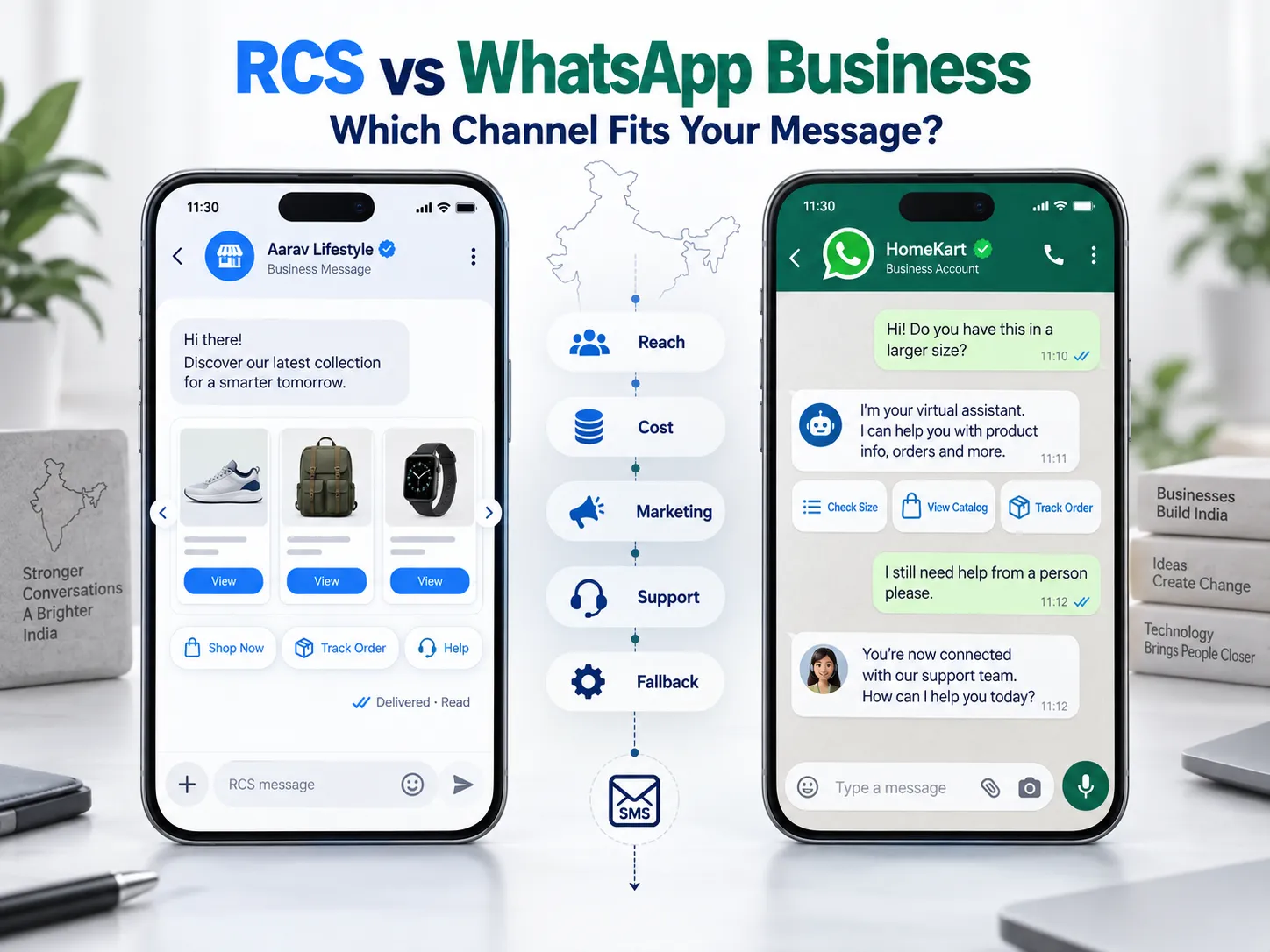
RCS for Business is becoming a serious option for Indian companies that want to send branded, interactive messages through a customer’s supported mobile inbox. WhatsApp Business Platform already gives businesses an established channel for campaigns, order updates, enquiries, authentication and automated support.
The practical question is not whether RCS will replace WhatsApp. It is which channel should handle each message.
A property card, appointment reminder, order update and customer-support conversation have different requirements. Reach, consent, provider charges, automation and team handling may matter more than the lowest advertised message rate.
As of 9 September 2026, RCS for Business is available in India through supported carriers and messaging partners. It does not reach every phone automatically. WhatsApp Business Platform is also available to Indian businesses, but customers must use WhatsApp, and platform charges depend on the recipient market and message category.
Key takeaways
- RCS delivers branded messages through a supported native messaging app.
- WhatsApp Business Platform delivers messages inside WhatsApp.
- RCS reach depends on the phone, operating system, network, messaging client and agent availability.
- RCS works on supported iPhones running iOS 18 or later, but carrier support is still required.
- WhatsApp provides a familiar environment for ongoing enquiries, support and automation.
- Neither channel has one universal business price.
- RCS quotations can vary by provider, carrier, traffic type, volume, rich-media format and fallback arrangement.
- WhatsApp charges according to delivered messages, recipient market and message category.
- Meta says service messages will become chargeable on 1 October 2026.
- Promotional communication requires valid consent and a functioning opt-out process.
- Indian businesses may benefit from using RCS, WhatsApp and SMS for different parts of the same customer journey.
What is RCS for Business?
RCS stands for Rich Communication Services. RCS for Business allows a company to communicate with customers through a supported mobile messaging application using a verified business profile.
Unlike an ordinary SMS sender ID, an RCS business profile can display the company’s name, logo, colours and verification status. Messages can contain images, videos, GIFs, audio, PDFs, rich cards, carousels, suggested replies and action buttons. Customers can also take actions such as opening a website, calling a number, viewing a location or replying to the business. Google’s RCS for Business overview
RCS can support one-way notifications and two-way conversations. Businesses can connect an RCS agent to customer-management systems, e-commerce tools, bots and other messaging channels.
A business will normally work with an RCS messaging provider or registered partner to create, verify, launch and operate its agent. Google maintains a directory of providers that can be filtered by supported region and service. Google’s RCS partner directory
Does the customer need another app?
The customer normally does not need to download a separate app belonging to the business. The message appears in a compatible messaging application on the phone.
That does not mean RCS works without technical conditions. The recipient needs:
- A compatible phone
- A supported mobile network
- An RCS-capable messaging application
- RCS enabled on the device
- Mobile data or Wi-Fi
- An RCS business route on which the sender’s agent has been launched
Google’s developer documentation states that a message can fail if the device does not support RCS, RCS is disabled, the agent is not launched on that network or the message contains an unsupported feature. Google’s RCS message-delivery documentation
What is WhatsApp Business Platform?
WhatsApp Business Platform is Meta’s API-based product for businesses that need messaging at a larger or more organised scale. It is different from the free WhatsApp Business mobile app.
The platform can support approved business-initiated messages, customer-service conversations, authentication, automated flows, bots, routing, CRM connections and live-agent handoffs. WhatsApp Business Platform
WhatsApp groups business messages into four categories:
- Marketing: Promotions, product suggestions, offers and retargeting
- Utility: Non-promotional updates connected to a customer action, such as an order or payment
- Authentication: One-time passwords used for identity verification
- Service: Responses to incoming customer enquiries
A customer message opens a 24-hour customer-service window. Until 30 September 2026, Meta’s public pricing page says service messages sent within that window are not charged. Meta’s developer pricing documentation states that service messages will become chargeable per delivered message from 1 October 2026, at the applicable utility-message rate. Businesses should review their payment method and provider quotation before that date. Meta’s WhatsApp pricing update
RCS vs WhatsApp Business in India
| Area | RCS for Business | WhatsApp Business Platform |
|---|---|---|
| Customer destination | Supported native messaging app | |
| Separate brand app needed | Usually no | No separate brand app, but WhatsApp must be installed |
| Reach dependency | Carrier, device, operating system, messaging client and agent route | Customer’s WhatsApp availability and account status |
| Business identity | Verified RCS agent with brand information | Business profile with available verification options |
| Rich content | Images, video, audio, PDFs, cards, carousels, replies and actions | Images, video, audio, documents, buttons, lists, catalogues and flows |
| Two-way conversation | Supported through conversational agents | Strong support for customer enquiries, bots and live agents |
| Marketing | Supported for consented recipients and approved use cases | Supported through marketing templates and platform rules |
| Transactional updates | Suitable for alerts, orders, appointments and delivery information | Suitable through utility templates |
| Authentication | Supports OTP and verification use cases | Authentication templates support OTP journeys |
| Customer support | Possible with conversational agents | Well suited to ongoing support and shared team handling |
| Billing | Provider, carrier and agent-billing model determine the retail cost | Charged by delivered message, recipient market and category |
| Fallback | Must be confirmed and configured with the provider | No automatic SMS fallback |
| Reporting | Can include delivery, read, click, action and reply data | Delivery, template, conversation and available campaign metrics |
| Customer opt-out | Agent and provider processes are required | Platform rules and business opt-out handling apply |
| Best fit | Native-inbox campaigns, rich notifications and interactive alerts | Enquiries, support, automation, follow-up and continuing relationships |
Does RCS work on iPhones in India?
Apple supports RCS on iPhones running iOS 18 or later, but the user also needs a mobile-data plan from a network provider that supports RCS on iPhone. Apple states that availability varies by region and network provider. Apple’s India RCS support guide
Apple also provides a separate setting for turning RCS Business Messages on or off where that option is available.
This confirms that RCS is no longer strictly an Android-only format. It does not confirm that every Indian iPhone can receive every business agent or interactive format.
Before counting iPhone users as reachable, a business should ask its provider:
- Which Indian carrier routes support its RCS agent?
- Does support cover consumer RCS only or RCS Business Messages as well?
- Which iPhone versions and message formats have been tested?
- How will unsupported numbers be identified?
- What happens when an RCS message cannot be delivered?
How RCS pricing works in India
There is no verified universal RCS tariff that applies to every Indian business, carrier and provider.
Google’s standard billing model currently classifies agents as conversational or non-conversational:
- Non-conversational agents are billed per delivered message.
- Conversational agents can be billed for a 24-hour conversation when one party responds to the other within the required period.
- If the recipient does not reply to a conversational agent’s business message within 24 hours, that message can be billed individually.
Google consolidated its older Basic Message and Single Message agent categories into the non-conversational category. The underlying billable events still distinguish shorter text messages from messages containing rich content or longer text. Google’s RCS billing FAQ
The amount paid by an Indian business can include:
- Carrier charges
- Messaging-provider margin
- Message or conversation category
- Rich-media format
- Monthly volume
- Agent setup and verification
- Platform access
- API or dashboard charges
- SMS fallback
- Automation or chatbot charges
- Support
- GST
Current provider-published examples
GreenAds Global published rates effective 1 September 2026 of ₹0.13 per transactional or conversational RCS message and ₹0.25 per promotional message, plus GST. These are GreenAds’ published rates, not official nationwide tariffs. GreenAds Global’s dated price page
SMS Gateway Hub published different indicative rates for the same effective date: approximately ₹0.11 per transactional message and ₹0.30 per promotional message, plus GST, with conversational pricing available by quotation. It states that actual rates can vary by operator, content and volume. SMS Gateway Hub’s dated price page
The difference between these published rates is why businesses should not budget an RCS campaign from one headline price.
How WhatsApp Business Platform pricing works
Meta charges businesses for messages it delivers, not messages that are merely submitted for sending. The rate depends on the recipient’s market and the message category. WhatsApp Business Platform pricing
Provider charges may be added to Meta’s platform rate. A quotation can also include:
- Monthly platform or licence fees
- Number hosting
- Template management
- Shared team inbox access
- Chatbot development
- CRM integration
- Automation
- Support
- GST
Meta offers volume-based pricing for eligible utility and authentication messages. It also provides special pricing treatment for certain customer-initiated entry points. Businesses should check the live rate card and their provider agreement instead of relying on an old WhatsApp price chart.
The 1 October 2026 service-message change
Meta’s developer documentation says service messages will become chargeable per message from 1 October 2026. The applicable service rate will match the utility-message rate for the recipient market.
This change can affect businesses that receive a large number of customer enquiries and send several replies inside the 24-hour service window. The exact cost will depend on how many messages are delivered and whether any current allowance or entry-point exemption applies.
Businesses should confirm:
- Whether their payment method is active
- The India service-message rate
- Any applicable volume tiers
- Provider fees
- Free-entry-point treatment
- How bot messages and human replies will be billed
- What happens if billing fails
Is RCS cheaper than WhatsApp?
Sometimes, but not in every situation.
A provider may quote a lower RCS promotional rate than Meta’s WhatsApp marketing rate. That comparison can still be misleading if it ignores unsupported recipients, SMS fallback, agent setup, minimum volume, platform fees or response handling.
The reverse can also happen. WhatsApp may be more useful even at a higher message rate if the customer already uses it to ask questions, share documents and continue a sales or service conversation.
Compare the total cost of reaching and managing a customer:
Total campaign cost = message charges + provider fees + fallback + setup + automation + support + taxes
Then compare that amount with delivered messages and useful outcomes, such as:
- Qualified enquiries
- Confirmed appointments
- Completed orders
- Successful deliveries
- Resolved support requests
- Valid authentication attempts
- Opt-outs and complaints
A cheap message that does not reach the right customer or creates an unmanageable reply queue is not necessarily the lower-cost channel.
Which channel suits each message?
Promotional launches and festive offers
RCS can suit visual campaigns that benefit from product cards, images, carousels and direct actions inside a supported mobile inbox.
WhatsApp can work well when customers have already opted in and the promotion is connected to an existing catalogue, conversation or follow-up journey.
Use neither channel for unsolicited bulk promotion from a purchased or scraped contact list.
Order, payment and delivery updates
RCS can present a branded notification with tracking, call or location actions. WhatsApp utility templates can place the update inside a conversation the customer may already use for support.
The best choice depends on customer availability, urgency, delivered cost and the fallback plan.
Customer support
WhatsApp is usually the more practical starting point for small and medium businesses that already receive enquiries there. It supports ongoing chats, media sharing, automation, shared access and live-agent handoff.
RCS can also support two-way service journeys, but the business must confirm conversational-agent availability, provider billing and how responses enter its support system.
OTPs and authentication
Both channels support authentication use cases. Neither should be treated as universally reachable.
An authentication flow needs a tested fallback because a customer who cannot receive the rich message may otherwise be unable to sign in or complete a transaction.
Time-sensitive alerts
RCS delivery may be retried when a recipient is temporarily offline. Google lets senders set message expiry for time-sensitive messages and recommends using a fallback strategy when a message cannot be delivered in time.
A business should not assume that every provider automatically sends an SMS fallback. The trigger, delay, SMS content and extra charge must be confirmed in writing.
Practical examples for Indian businesses
Real estate
An RCS campaign could present project images, property cards, directions and a site-visit button to supported recipients.
WhatsApp is better suited to the next stage: answering budget questions, collecting requirements, assigning the lead to an agent and following up after a site visit.
For a Mira Road or Bhayandar property campaign, the business should separate buyers by preferred location, budget and configuration before sending messages. A large send to unqualified contacts can waste budget on either platform.
Retail and e-commerce
RCS can display a product launch or seasonal collection through cards and buttons. WhatsApp can manage product questions, cart recovery, order support and returns.
Before using RCS, exclude unavailable products and confirm whether an undelivered campaign will fall back to SMS. Before using WhatsApp, confirm the correct marketing or utility category for each template.
Clinics
RCS can handle appointment reminders with confirmation actions. WhatsApp can support rescheduling and staff replies.
Avoid placing unnecessary medical information in either message. Consent, access controls and the handling of sensitive information should be reviewed before automation is introduced.
Education and coaching
RCS can send admission reminders, class notices and event updates. WhatsApp can handle counselling questions, document requirements and parent or student support.
Promotional admission campaigns should be kept separate from service updates sent to enrolled students.
Local service businesses
A salon, repair company or interior designer could use RCS for a branded offer or booking prompt. WhatsApp can continue the conversation, collect requirements, share a quotation and confirm the appointment.
A small business should first test whether its customer base is reachable through RCS before committing to a large plan.
Compliance and customer consent in India
TRAI states that businesses using telecom resources to send bulk communication must meet applicable requirements under the Telecom Commercial Communications Customer Preference Regulations. These can include Principal Entity registration, registered headers, content templates and customer consent. TRAI’s guidance for commercial senders
The exact requirements can depend on the channel, route, carrier and message purpose. An RCS or WhatsApp provider should explain which registrations and approvals apply to the proposed setup.
Businesses should maintain:
- Clear records showing how consent was collected
- A description of the messages covered by that consent
- Separate treatment for promotional and transactional communication
- An accessible opt-out method
- A suppression list for customers who opt out
- Approved templates where required
- Records of campaign dates, recipients and message purpose
- A process for handling complaints
A DLT registration does not replace customer consent. A verified sender badge also does not make every message, link or offer automatically trustworthy.
The Vertex Social R.E.A.C.H. framework
The R.E.A.C.H. framework is a practical Vertex Social decision tool, not an official platform or regulatory framework.
R: Recipient availability
Check how many intended recipients use WhatsApp and how many can receive the proposed RCS agent on their phone and network.
Ask the RCS provider to run a capability check and explain how unavailable recipients are handled.
E: Engagement purpose
Classify each message before selecting a channel:
- Promotion
- Transactional update
- Authentication
- Service response
- Lead qualification
- Appointment or site-visit reminder
Do not combine promotional copy with a transactional message simply to obtain a lower rate.
A: Actual delivered cost
Request a complete quotation that covers message charges, setup, verification, platform fees, fallback, automation, support and GST.
Compare delivered cost and qualified outcomes, not only the lowest advertised rate.
C: Consent and compliance
Confirm how consent was collected, which communication it covers, how customers can opt out and which TRAI, carrier or platform rules apply.
H: Handoff and measurement
Decide where customer replies will go.
A campaign should have:
- A bot or team member responsible for the first response
- Rules for assigning enquiries
- Response-time expectations
- CRM or lead-sheet updates
- Escalation to a person
- Reporting for qualified outcomes
- Opt-out and complaint handling
What to ask an RCS provider before signing
Request written answers to these questions:
- Which Indian carriers, Android devices and iPhones can this agent reach?
- Does the quoted coverage include RCS Business Messages?
- How is recipient capability checked?
- Which agent billing category will be used?
- Is the price per delivered message, attempted message or conversation?
- Are different rates used for text, rich cards, carousels and promotional traffic?
- Are setup, verification, platform access, support and GST included?
- Is there a minimum volume or monthly commitment?
- What happens when RCS cannot be delivered?
- Is SMS fallback included, optional or separately charged?
- How quickly does fallback occur?
- How are replies routed to a chatbot, CRM or employee?
- Which delivery, read, click, reply and opt-out reports are available?
- Which consent, DLT, template and sender-registration requirements apply?
- Who owns the agent and customer data if the business changes providers?
What Indian businesses should avoid
- Do not assume RCS reaches every Indian mobile number.
- Do not treat iOS 18 as proof that every iPhone can receive business RCS.
- Do not present one provider’s rate as India’s official RCS price.
- Do not compare an RCS promotional rate with a different WhatsApp message category.
- Do not assume SMS fallback is automatic or free.
- Do not send promotional campaigns to purchased contact lists.
- Do not treat DLT registration as customer consent.
- Do not mix promotional content into transactional notifications.
- Do not launch a large campaign before testing device capability and delivery.
- Do not collect replies unless a bot or team member is ready to handle them.
- Do not judge a campaign using read rates alone.
- Do not claim that verified identity prevents every scam or unsafe link.
- Do not expect either channel to guarantee enquiries, sales or lower acquisition costs.
Frequently asked questions
Is RCS for Business available in India?
Yes. Google provides an India-specific RCS for Business site, and Indian providers including Jio offer business RCS services. Actual reach depends on the recipient’s carrier, device, operating system, messaging application and the agent’s supported routes.
Is RCS the same as SMS?
No. RCS uses data and can support branding, rich media, interactive controls, read receipts and two-way journeys. SMS has fewer features but remains important for broad reach and fallback.
Does RCS work on iPhones in India?
It can work on supported iPhones running iOS 18 or later when the network provider supports RCS. Support should be confirmed by carrier and business-message route.
Is WhatsApp Business Platform the same as the WhatsApp Business app?
No. The app is designed mainly for smaller businesses managing communication from phones and linked devices. The Platform is an API-based product used for larger messaging, automation and system integration.
Is RCS always cheaper than WhatsApp?
No. Prices vary by RCS provider, carrier, message type and volume. WhatsApp prices vary by recipient market and category. Setup, fallback, provider fees and automation must also be included.
Does RCS always fall back to SMS?
No universal fallback should be assumed. Google’s developer documentation allows businesses to use fallback methods, but the actual process depends on the provider and technical configuration.
Can RCS and WhatsApp connect with a chatbot or CRM?
Yes, subject to the selected provider and integration. RCS can connect agents with business systems, while WhatsApp Business Platform supports automation, bots, routing and CRM connections.
Should a small business use RCS or WhatsApp?
WhatsApp may be the easier starting point when customers already send enquiries there and the business needs ongoing conversations. RCS may add value for branded native-inbox campaigns and interactive alerts. A reach and cost test should come before a large commitment.
Should your business use RCS, WhatsApp or both?
Choose RCS when the message benefits from a branded native-inbox experience and the intended audience has been confirmed as reachable.
Choose WhatsApp when continuing conversations, customer support, shared team handling and automation are central to the journey.
Use both when one channel creates attention and the other manages the response. Keep SMS available where broad or time-sensitive reach requires a tested fallback.
The cheapest headline rate is not always the lowest real cost. Compare recipient availability, message purpose, delivered cost, consent, fallback and team workflow before selecting a channel.
Vertex Social can review an existing WhatsApp enquiry and automation setup, then help the business identify where RCS or SMS may require separate provider testing.