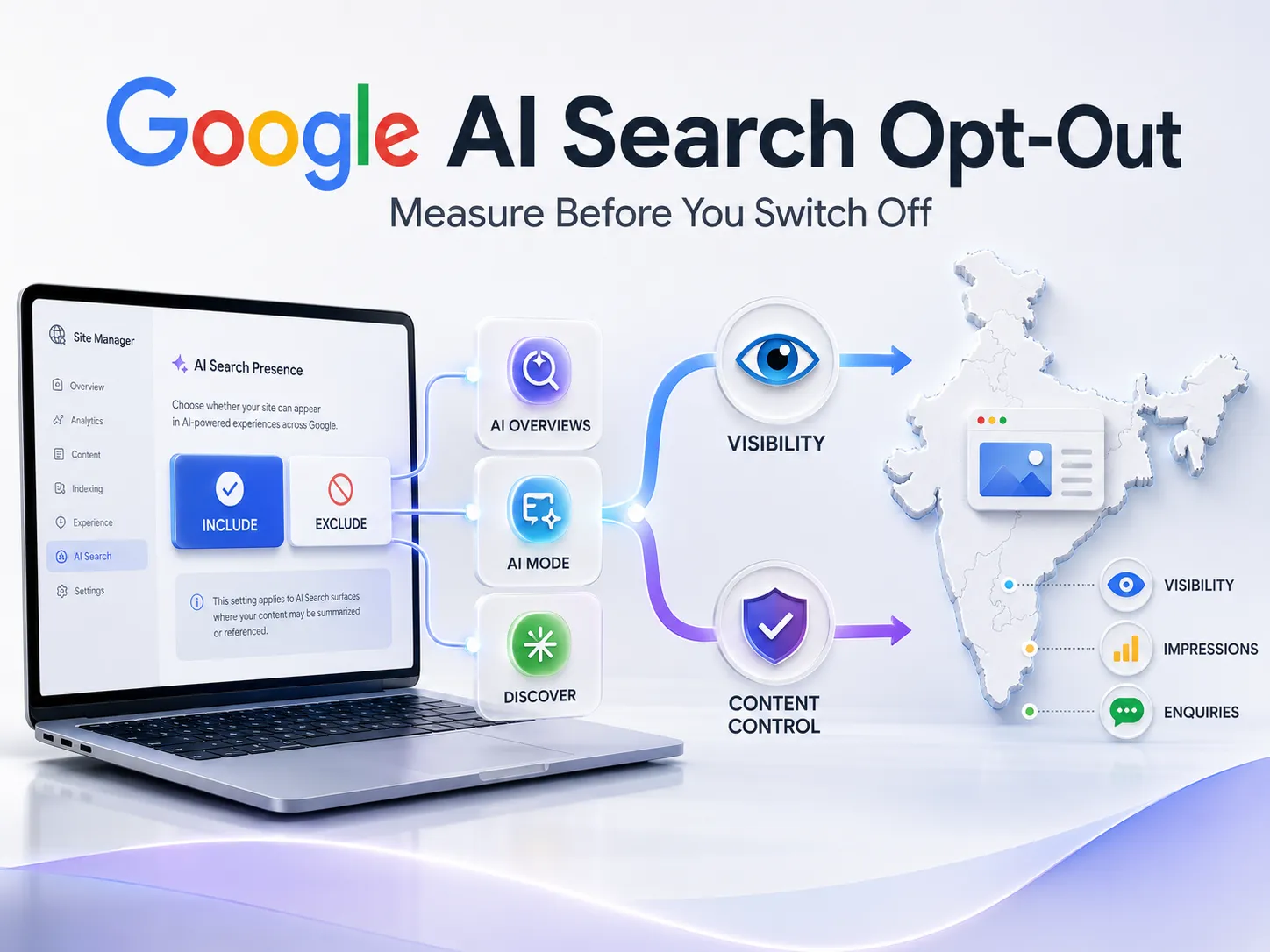
Google has completed the worldwide rollout of a Search Console control that allows website owners to exclude their links and content from selected generative AI features in Google Search.
The control was originally announced on 3 June 2026 and initially tested with selected UK website owners. Google updated its announcement after completing the worldwide rollout on 31 August 2026. It is now available to Indian website owners through applicable Search Console properties. Google’s announcement
Using the control is not a minor privacy setting. Exclusion removes a website’s eligibility to appear as a link or contribute to responses in AI Overviews, AI Mode and generative AI features in Discover. The excluded website will consequently lose impression and traffic opportunities from those surfaces.
Google says this choice is not used as a ranking or inclusion signal affecting other parts of Search. However, that does not mean opting out has no visibility consequences.
For most Indian lead-generation, local-business and e-commerce websites, the sensible starting position is to remain included, examine the available data and understand the commercial value before turning off an emerging discovery channel.
Key takeaways for Indian website owners
- Google originally announced the control on 3 June 2026.
- The worldwide rollout was completed on 31 August 2026.
- The setting is available through Search Console in India.
- Websites are included by default.
- The control covers AI Overviews, AI Mode and generative AI features in Discover.
- Excluded content cannot appear as links or help ground responses in the covered features.
- An excluded website will not receive impressions or traffic from those features.
- Google says exclusion is not used as a ranking or inclusion signal elsewhere in Search.
- The control does not remove the website from traditional Google Search.
- It does not prevent Google from crawling the website.
- It does not control AI training.
- Parent Search Console settings can be inherited by child properties.
- Most Indian business websites should measure visibility and business value before excluding themselves.
What has Google announced?
Google introduced the control as part of a broader set of tools intended to give website owners more information and choice as generative AI becomes more prominent in Search.
According to Google, AI Overviews has more than 2.5 billion monthly active users, while AI Mode has surpassed one billion monthly users. These are Google-reported global user figures. They are not Indian website-referral numbers, India-specific usage statistics or evidence that every website receives AI Search traffic. Google’s website-owner announcement
The control can be found under:
Search Console → Settings → Search generative AI
The default option allows a website’s links and content to appear in the covered features. Website owners can instead choose exclusion or, where applicable, inherit the setting from a parent property. Google Search Console’s control documentation
There is no application deadline and no requirement to change the setting. A website remains included unless the relevant Search Console property is configured to exclude it.
Which Google AI features does the setting cover?
Google currently lists three covered areas:
- AI Overviews
- AI Mode
- Generative AI features in Google Discover
Google says it expects to update this list as Search develops. Website owners should therefore review the documentation periodically rather than assuming the scope will remain unchanged.
AI Overviews
AI Overviews provide AI-generated summaries for searches where Google determines that an overview may add value. They can include links that allow searchers to explore supporting websites.
AI Mode
AI Mode is a conversational Search experience designed for more detailed questions, comparisons and follow-up queries. Google began rolling it out to everyone in India in July 2025, initially in English and without requiring a Search Labs registration. Google’s India AI Mode announcement
Generative AI in Discover
The control also covers generative AI features within Google Discover. Search Console provides a separate generative AI performance view for Discover where applicable.
Google has not said that every user will see these features for every query. Global availability of the control also does not guarantee that every Indian website has appeared in an AI-generated result.
What happens if a website opts out?
Exclusion produces a specific set of consequences.
| Area | What Google says happens after exclusion |
|---|---|
| AI Overviews | The website’s links and content cannot appear in the feature |
| AI Mode | The website becomes ineligible to appear or help ground responses |
| Generative AI in Discover | The website cannot appear in the covered generative feature |
| AI impressions | The website will not receive impressions from the covered features |
| AI Search traffic | The website will not receive traffic from the covered features |
| Other Search results | The control is not used as a ranking or inclusion signal |
| Google crawling | The control does not prevent normal Search crawling |
| AI training | The control does not manage AI training |
| Merchant Center and Ads | Separate participation choices continue to apply |
Google also warns that information from other websites may still appear and may be similar to the excluded website’s content. Opting out does not prevent competitors, news publications or other sources from covering the same subject. Google Search Console Help
How quickly does exclusion take effect?
Google says a control change generally takes a few days to process. Exclusion begins within approximately one to two days after the control goes live, although cached content and propagation across Google’s systems can cause some material to remain visible for longer.
The setting can be changed again, but visibility will not necessarily return immediately. Inclusion also does not guarantee that Google will select or display the website in any AI-generated result.
Does opting out affect normal Google rankings?
Google says the Search generative AI control is not used as a ranking or inclusion signal affecting other parts of Search.
That means exclusion is not the same as removing a page from Google’s ordinary Search index.
However, it would be misleading to reduce the decision to “there is no SEO effect.” An excluded website loses eligibility for:
- Links in the covered generative AI features
- Generative AI impressions
- Potential visits from those links
- Discovery through searches that may be answered through AI Overviews or AI Mode
Traditional organic visibility and generative AI visibility are related parts of the wider Search experience, even when the control does not directly change conventional ranking signals.
A website can therefore remain indexed in traditional Search while losing an additional group of AI-assisted discovery opportunities.
Is the AI Search opt-out the same as blocking AI training?
No. This is the most important distinction website owners need to understand.
The Search generative AI control manages whether a website can appear and help ground answers in particular Google Search features. Google explicitly says that the setting does not affect AI training.
Google-Extended is a separate robots.txt product token. Google says publishers can use it to manage whether crawled content may be used for training future generations of certain Gemini models and for grounding in specified Gemini and Vertex AI products. Google also says Google-Extended does not affect inclusion or ranking in Google Search. Google’s crawler and Google-Extended documentation
These controls serve different purposes:
| Control | Primary purpose |
|---|---|
| Search generative AI control | Manages participation in covered generative AI Search features |
| Google-Extended | Manages specified training and grounding uses outside the Search participation setting |
| noindex | Prevents a page from appearing in Google Search after processing |
| Snippet controls | Limit the amount or portion of content that Google may show as a Search preview |
| robots.txt for Googlebot | Manages crawling access, with wider implications for Search |
Businesses should not modify robots.txt, noindex instructions or snippet controls without understanding their broader effects. A technical mistake can remove more visibility than intended.
Is the control available to Indian websites?
Yes. Google states that the control has been rolled out to all websites worldwide. This includes applicable Search Console properties belonging to Indian websites.
India is relevant for more than technical availability. AI Mode has been available to Indian users since 2025, and Indian companies rely on Google Search for local discovery, product research, service comparisons and enquiries.
An Indian website owner may nevertheless see little or no generative AI performance data. Possible reasons include:
- The website has not appeared in the covered features
- The property lacks sufficient impressions
- The wrong Search Console property is being reviewed
- The selected date range is too short
- Relevant pages are not indexed or eligible for Search snippets
- AI features did not appear for the queries relevant to the website
Google says a page must be indexed and eligible to appear in Search with a snippet to qualify as a supporting link in AI Overviews or AI Mode. Meeting those conditions still does not guarantee inclusion. Google’s AI features and website guidance
Google has not published India-only opt-out adoption figures, referral rates or conversion data. It has also not issued a recommendation telling all Indian websites to remain included or opt out.
Should Indian websites turn off AI Overviews?
There is no single correct answer for every website.
A local service business trying to generate calls has a different commercial model from a subscription publication protecting expensive research. The decision should reflect how the website earns value.
| Website type | Recommended starting position |
|---|---|
| Local service business | Remain included and measure visibility |
| Lead-generation website | Remain included and track qualified enquiries |
| Real-estate website | Remain included and review service and listing-page exposure |
| E-commerce website | Usually remain included; review Merchant Center separately |
| Clinic or professional practice | Remain included while checking accuracy and compliance |
| News publisher | Conduct a referral, advertising and licensing assessment |
| Subscription publication | Compare discovery value with subscription and content-control concerns |
| Proprietary research provider | Assess whether protection outweighs discovery |
| Mixed-content website | Consider carefully configured child properties instead of a blanket decision |
These are practical Vertex Social recommendations, not Google requirements.
Local and lead-generation businesses
A property consultant in Bhayandar, clinic in Mumbai, restaurant in Pune or service company in Bengaluru generally wants more qualified discovery.
If its website contains service information, location pages, guides and customer FAQs, excluding the entire site before measuring visibility may remove an emerging path through which potential customers can encounter the business.
Remaining included does not guarantee citations or enquiries. It simply preserves eligibility while the business gathers evidence.
E-commerce websites
An e-commerce company may gain discovery when users ask comparative or detailed product questions. Before opting out, it should examine which category, product and buying-guide pages receive AI impressions.
Google states that the Search generative AI control does not override separate participation decisions for Merchant Center or Google Ads. Those systems should be reviewed independently.
Publishers and subscription businesses
A publisher may place greater commercial value on direct visits, advertising impressions, subscriptions and control over expensive editorial work.
For such a business, the question is not merely whether AI Search creates visibility. It is whether that visibility produces enough commercial value to justify participation.
The assessment should include:
- Referral traffic
- Subscriber conversions
- Advertising revenue
- Content-production cost
- Licensing strategy
- Brand discovery
- Citation quality
- Dependence on direct readership
Opting out may be reasonable for some publishers, but it should follow a commercial assessment rather than a general fear of AI.
Proprietary research providers
A company publishing original datasets, paid analysis or commercially sensitive research may have stronger reasons to restrict participation.
It should first separate genuinely proprietary material from ordinary public marketing pages. Excluding the entire domain may unnecessarily remove service pages, company information and public resources that are intended to attract customers.
The Measure Before You Switch Off framework
Vertex Social recommends a four-part decision process for Indian website owners.
1. Measure visibility
Open the dedicated generative AI performance report in Search Console and examine:
- Impressions
- Appearing pages
- Countries
- Devices for Search
- Performance by date
Google completed the worldwide rollout of these dedicated reports on 31 August 2026. The reports provide separate views for generative AI visibility in Search and Discover. Google Search Central’s reporting announcement
Do not judge the opportunity from a single day. Compare multiple periods and note whether visibility is stable, growing, falling or concentrated around a small number of pages.
2. Identify business value
An impression shows that a URL appeared. It does not prove that somebody visited the website, submitted a form or made a purchase.
Compare the visible pages against wider Search Console, analytics and enquiry data.
Ask:
- Are important service or product pages appearing?
- Are the pages relevant to the business’s ideal customers?
- Did organic landing-page visits change during the same period?
- Are visitors reaching enquiry, appointment or purchase pages?
- Are branded searches increasing?
- Do sales conversations mention information found through Google?
- Which pages generate commercially useful actions?
A page with many impressions but no clear action may need a better next step. A lower-impression page may still be valuable if it attracts a small number of relevant buyers.
3. Assess content sensitivity
Classify the website’s content before making a control decision.
Ordinary discovery content may include:
- Service descriptions
- Product information
- Location pages
- Public FAQs
- Portfolio summaries
- Educational articles
- Company information
Potentially sensitive content may include:
- Paid research
- Subscriber-only analysis
- Original commercial datasets
- Proprietary methodologies
- Licensed publications
- High-cost editorial investigations
A business should not describe common marketing information as proprietary simply because it took time to write. The question is whether restricting access protects measurable commercial value.
4. Decide and monitor
Choose among three practical positions:
- Remain included: Suitable when discovery and lead generation are the priority.
- Exclude an appropriate property: Suitable when the commercial case for control is stronger.
- Separate content through correctly verified child properties: Potentially useful for mixed websites when only a specific section requires different treatment.
Record the date, property, previous setting, reason and baseline performance before making a change. Monitor the following weeks for changes in AI impressions, organic landing-page activity and business enquiries.
Because search demand and reporting fluctuate, a simple before-and-after comparison cannot prove that the control caused every change. Treat the result as evidence to review, not a guaranteed experiment.
Can the opt-out apply to only part of a website?
Potentially, but the Search Console property structure must be configured correctly.
Google explains that child properties inherit the setting of the closest manually configured parent by default. A verified owner can manually override the setting for a child property and its subpages.
For example, a website may have:
- A top-level domain property covering the entire website
- A URL-prefix property covering the main website
- A narrower URL-prefix property covering a research or publication section
A child property can be assigned a different setting when properly configured. However, an incorrect property structure or assumption about inheritance can affect more content than intended.
Before changing a mixed website, check:
- Which property is currently selected
- Whether it inherits from a parent
- Which URLs fall under the child property
- Whether the person making the change has verified ownership
- Whether Merchant Center, advertising or other participation settings require separate attention
A technical Search Console review is advisable when property relationships are unclear.
What remains uncertain?
Despite the worldwide rollout, several questions remain unanswered:
- Google has not published India-specific adoption figures.
- India-only generative AI referral rates are unavailable.
- City and state-level AI Search usage data has not been published.
- Google has not guaranteed which websites or queries will trigger AI visibility.
- The covered-feature list may change.
- Additional performance metrics may be added later.
- Inclusion does not guarantee a citation, impression, click or enquiry.
- Exclusion does not prevent similar information from appearing through other sources.
- The control does not provide complete protection against copying or summarisation outside its documented scope.
- Google has not recommended one setting for all Indian businesses.
Website owners should review the decision periodically as Search features, reporting and their own commercial model change.
What Indian businesses should avoid doing
Do not opt out because of a frightening headline
The decision affects a real visibility channel. It should be based on business value, content sensitivity and website data.
Do not confuse Search exclusion with AI-training control
The Search Console setting does not control AI training. Google-Extended is a separate mechanism with a different scope.
Do not use noindex as a substitute
Noindex is used to block content from Google Search completely. It should not be applied merely because a business wants to leave selected AI Search features.
Do not assume normal rankings are the complete picture
Google says the control is not a ranking signal elsewhere in Search, but exclusion still removes links, impressions and traffic opportunities within the covered features.
Do not make an unrecorded site-wide change
Document the property, previous setting, date and baseline data. Otherwise, later performance comparisons will be difficult.
Do not expect immediate or perfectly isolated results
Processing, caching, seasonality, ranking changes and search demand may all influence the numbers observed after a change.
Do not assume inclusion guarantees visibility
Google does not guarantee that an eligible page will appear in AI Overviews, AI Mode or Discover.
Frequently asked questions
Is the Google AI Overviews opt-out available in India?
Yes. Google completed the worldwide rollout on 31 August 2026, making the Search Console control available to applicable Indian website properties.
Are websites included by default?
Yes. Google says inclusion is the default control for properties.
Will opting out remove my website from normal Google Search?
No. Google says this control is not used as a ranking or inclusion signal for other parts of Search. Complete Search removal requires different controls, such as noindex.
Will my website lose AI Search impressions and traffic?
Yes. Google says an excluded website will not receive impressions or traffic from the covered generative AI features.
Does the setting stop Google from crawling my website?
No. It is not a general crawling control.
Does it stop Google from using my content for AI training?
No. Google explicitly says the Search generative AI control does not affect AI training.
Is Google-Extended the same as the AI Search opt-out?
No. Google-Extended manages specified training and grounding uses associated with certain Gemini and Vertex AI products. The Search Console control manages participation in covered generative AI Search features.
How long does the change take?
Google says exclusion starts within approximately one to two days after the control becomes active, although the overall process generally takes a few days and cached content may take longer to disappear.
Can the decision be reversed?
The property setting can be changed again. However, re-inclusion does not guarantee immediate visibility or selection in AI-generated results.
Can I exclude only one section of my website?
A properly verified child Search Console property can override an inherited parent setting for the URLs it covers. Property structure and inheritance should be checked carefully before making the change.
Should a local Indian business opt out?
Usually not without measuring first. Local and lead-generation websites normally benefit from preserving relevant discovery opportunities unless they have a specific content-control reason.
Should an Indian publisher opt out?
It depends on referral traffic, subscriptions, advertising, licensing and content-production economics. Publishers should conduct a separate commercial assessment.
What Indian website owners should do next
Do not treat the new control as a compulsory switch or an automatic SEO opportunity.
First, review the relevant Search Console property and determine whether the website has received generative AI impressions. Identify which pages appear, whether they serve valuable business searches and whether visitors have a clear route from discovery to enquiry, purchase or subscription.
Then distinguish ordinary public website content from material with genuine proprietary or subscription value.
For most Indian lead-generation businesses, remaining included while measuring performance is the stronger starting position. Publishers and proprietary-content companies may reach a different conclusion after evaluating referral value, licensing and content economics.
AI Search visibility is useful only when a website contains helpful content, has a technically sound structure and makes the next step clear. Vertex Social can help connect Search Console evidence with the website’s content, SEO health and enquiry journey before a business changes the setting.