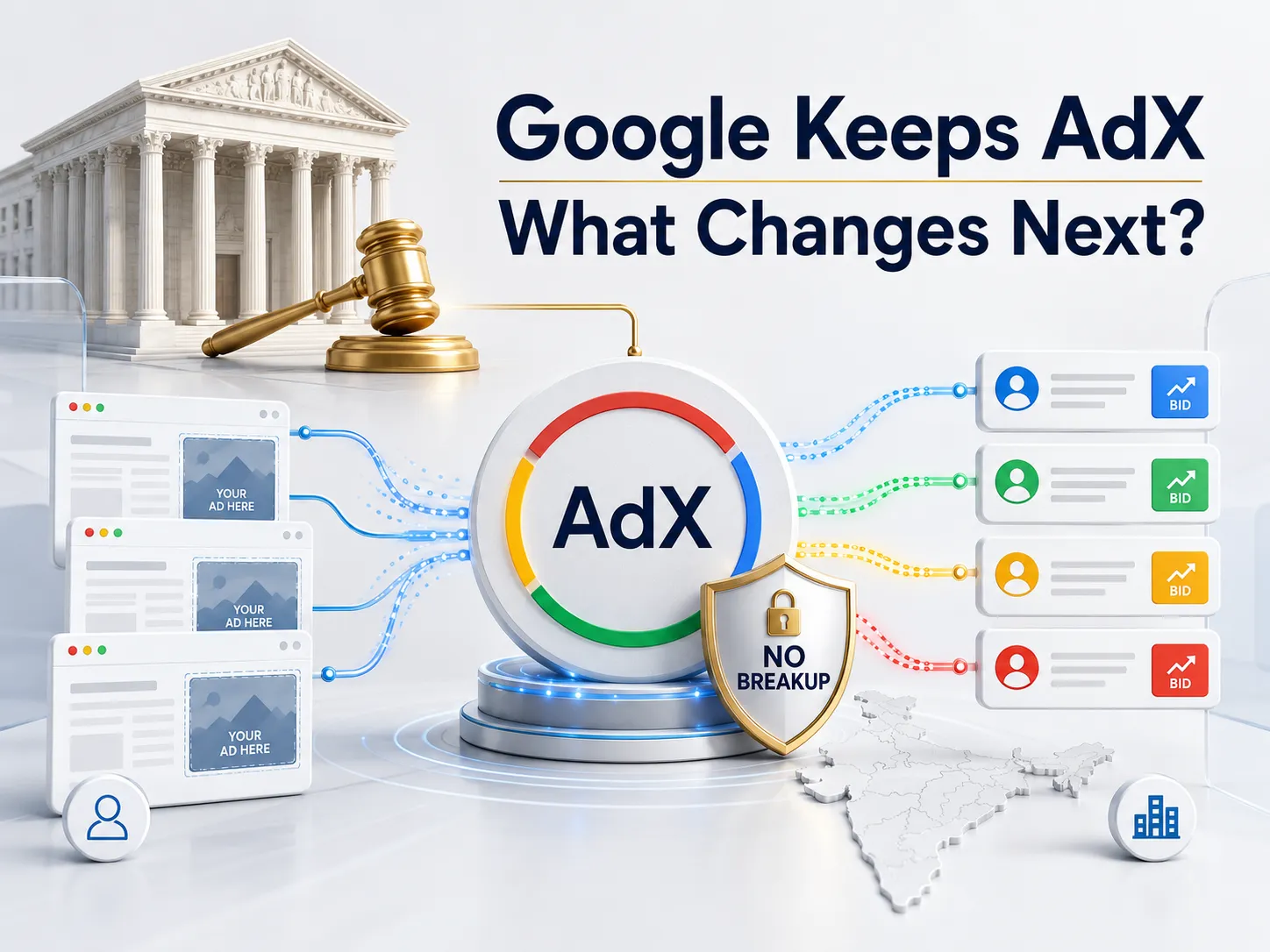
Google has avoided the most severe remedy sought in a major US advertising-technology antitrust case: the forced sale of its AdX advertising exchange.
On 2 September 2026, US District Judge Leonie M. Brinkema rejected the Department of Justice’s proposed AdX divestiture. The court nevertheless accepted behavioural remedies intended to address Google’s previously established antitrust violations. Reuters reported that the detailed opinion will remain sealed for 14 days while confidential information is reviewed and redacted.
The distinction matters. Google has not escaped every remedy, but the company has not been ordered to break up its ad-tech business either.
It is equally important to understand which advertising products the case covers. The ruling primarily concerns publisher technology used to manage and sell open-web display advertising—particularly Google’s publisher ad server, formerly known as DoubleClick for Publishers or DFP, and its AdX exchange.
It does not currently announce changes to Google Search Ads, YouTube Ads, Performance Max, advertiser targeting or Indian Google Ads pricing.
For Indian publishers, agencies and advertisers, the immediate task is therefore to understand the scope of the ruling, avoid premature campaign changes and monitor the complete public remedy order when it becomes available.
Key takeaways
- Google does not have to sell AdX under the 2 September ruling.
- The court accepted behavioural remedies instead of the proposed structural breakup.
- The detailed remedies remain sealed as of 3 September 2026.
- Google was previously found liable for civil antitrust violations involving two publisher-side open-web advertising markets.
- The court did not find Google liable on the alleged advertiser ad-network market.
- Google’s real-time bid-access proposal should not yet be described as a confirmed final remedy.
- No immediate change to Search Ads, YouTube Ads, Performance Max or Indian campaign settings has been announced.
- Indian publishers are more directly connected to the case than ordinary small-business advertisers.
- Businesses should monitor implementation details instead of assuming that advertising prices, publisher revenue or campaign performance will change.
What did the US court decide on 2 September 2026?
The Department of Justice had asked the court to require Google to sell AdX. That would have been a structural remedy—one that separates or sells part of a company rather than merely changing how it operates.
Judge Brinkema declined to order that sale.
According to Reuters, the judge accepted behavioural remedies and said that a detailed ruling would be released after a 14-day confidentiality and redaction period. Associated Press likewise reported that Google must rework parts of its digital-advertising system while being spared the requested breakup.
A behavioural remedy changes what a company is allowed or required to do. It can involve matters such as access, interoperability, auction practices, data sharing or restrictions on particular business conduct.
Google had proposed giving competing publisher ad servers access to real-time AdX bids. However, because the complete opinion remains sealed, it is not yet safe to say that the final public order contains this measure in precisely that form, scope or geographic coverage.
What is confirmed?
| Question | Confirmed position as of 3 September 2026 |
|---|---|
| Must Google sell AdX? | No. The requested forced sale was rejected. |
| Did Google avoid every remedy? | No. The court accepted behavioural remedies. |
| Are the complete requirements public? | No. The detailed opinion remains sealed for redaction. |
| Has real-time bid access been discussed? | Yes. Google proposed it as a remedy. |
| Is the final form of that access public? | Not yet. |
| Is there a confirmed Indian implementation date? | No. |
| Must advertisers change campaigns now? | No immediate campaign-setting change has been announced. |
| Could either side take further legal action? | Further steps remain possible, but their final form is not confirmed. |
What did the court previously find Google had monopolised?
The remedies decision follows an important liability judgment issued on 17 April 2025.
In that judgment, the US District Court for the Eastern District of Virginia found that Google had:
- Willfully acquired and maintained monopoly power in the open-web display publisher ad-server market
- Willfully acquired and maintained monopoly power in the open-web display ad-exchange market
- Unlawfully tied its publisher ad server, DFP, to its AdX exchange
- Violated Sections 1 and 2 of the Sherman Act through that tying conduct
These findings appear in the court’s April 2025 memorandum opinion, hosted by the US Department of Justice.
The same opinion states that the plaintiffs failed to prove a relevant market for open-web display advertiser ad networks. Google was therefore not held liable on that advertiser-side monopolisation claim.
This is why it would be inaccurate to say that the court found Google had monopolised every part of online advertising—or Google Ads as a whole.
The ad-tech stack in simple language
The case can be difficult to follow because “Google advertising” describes several different products and functions.
What is a publisher?
A publisher is a website or digital property that has advertising space to sell. News websites, content platforms and other advertising-supported websites are common examples.
What is a publisher ad server?
A publisher ad server helps a website manage its advertising inventory and decide which advertisements are eligible to appear in available spaces.
Google’s publisher ad server was historically known as DoubleClick for Publishers, or DFP. It is now associated with Google Ad Manager.
What is an ad exchange?
An ad exchange is an automated marketplace that connects demand for advertisements with advertising space supplied by publishers.
When a user loads a webpage, advertisers or their technology providers can compete for the available space through a rapid automated auction.
What is AdX?
AdX is Google’s advertising exchange. It sits between publishers selling advertising space and buyers competing for that space.
Reuters describes AdX as an exchange where publishers pay Google a 20% fee when selling advertising through instant auctions. That is a reported existing AdX fee—not a new fee created by the September ruling.
What is open-web display advertising?
Open-web display advertising generally refers to graphical advertising shown on independent websites outside closed platforms.
This is different from an advertisement displayed within Google Search results, a YouTube video or a social platform such as Instagram.
AdX versus Google Ads: what is the difference?
Google Ads is the platform many businesses use to create and manage advertising campaigns. AdX is an exchange used within the publisher-side advertising ecosystem.
| Product or area | Primary role | Directly covered by this ruling? |
|---|---|---|
| Google AdX | Exchange connecting advertising demand with publisher inventory | Yes |
| DFP/publisher ad server | Helps publishers manage advertising inventory | Yes |
| Google Ad Manager | Publisher monetisation and advertising-management environment containing relevant technology | Relevant to the case |
| Google Search Ads | Advertisements appearing in Google Search results | No immediate change announced |
| YouTube Ads | Advertising within YouTube | No immediate change announced |
| Performance Max | Google Ads campaign type operating across Google inventory | No immediate change announced |
| Meta Ads | Advertising on Facebook and Instagram | No |
| In-app advertising generally | Advertising displayed inside mobile applications | Not the central market addressed |
An Indian company running a Search campaign for “website development in Mumbai” is not using AdX in the same way that a news publisher uses Google’s publisher-side technology to sell display inventory.
The wider advertising ecosystem may eventually experience indirect effects. That does not make the ruling a new Google Ads campaign update.
The Vertex Social Ruling-to-Reality Check
Vertex Social’s four-part framework helps separate the legal headline from its practical business meaning.
1. What the court found
The court found that Google unlawfully maintained monopoly power in two open-web display advertising-technology markets: publisher ad servers and ad exchanges.
It also found that Google unlawfully tied DFP to AdX.
2. What the court rejected
The judge rejected the proposed forced sale of AdX.
Google therefore avoided the structural breakup requested by the Justice Department.
3. What remains unknown
The detailed behavioural requirements and implementation schedule are not yet fully public.
Until the redacted opinion is released, important questions remain:
- Which Google products must change?
- What precise access must be provided to competitors?
- Which auction practices will be restricted?
- What monitoring or reporting will be required?
- When will each obligation take effect?
- Will the requirements apply only to US activity or more broadly?
- Will either side challenge parts of the decision?
4. What businesses should monitor
Publishers, agencies and advertising professionals should watch five areas:
- Interoperability between Google and competing publisher technology
- Access to real-time bidding information
- Changes to publisher auction processes
- Implementation dates and geographic scope
- Observable effects on publisher choice, competition and revenue
None of these should be converted into guaranteed financial outcomes before implementation evidence is available.
What does the ruling mean for Indian publishers?
Indian publishers participate in a wider advertising ecosystem that includes global platforms, programmatic buyers, ad servers and exchanges.
The judgment comes from a US federal court; it is not an Indian court ruling or Indian advertising regulation. Nevertheless, Google operates advertising infrastructure globally, and the April 2025 opinion noted that AdX and DFP are used by publishers in the United States and worldwide.
That creates potential relevance for Indian publishers—but not a confirmed immediate operational change.
Indian publishers should examine their current ad-tech setup
A publisher should understand:
- Which ad server manages its inventory
- Whether and how it uses AdX
- Which other exchanges or demand partners compete for inventory
- How auctions are configured
- What fees and revenue shares apply
- Whether the publisher has meaningful alternative technology options
- How much revenue depends on Google-managed infrastructure
This creates a baseline against which future implementation changes can be evaluated.
Do not assume publisher revenue will increase
Greater competition or interoperability could theoretically create more choice. It does not automatically follow that every publisher will earn more.
Publisher revenue can also be affected by:
- Audience quality and location
- Advertiser demand
- Ad formats and viewability
- Seasonality
- Consent and privacy requirements
- Page speed
- Direct advertising agreements
- Traffic volume
- Auction configuration
- Content quality and brand safety
A court remedy may change part of the market structure without producing the same financial result for every website.
Avoid premature platform migration
The full public order is not yet available, and implementation may take time.
Moving away from an existing ad server or exchange can affect reporting, revenue, technical integrations and advertising operations. Publishers should not make a costly migration based solely on the breakup headline.
What does it mean for Indian Google Ads advertisers?
For most Indian businesses using Google Ads, the immediate impact is limited.
No confirmed change has been announced for:
- Search campaign settings
- Search Ads eligibility
- Keyword targeting
- Performance Max
- YouTube advertising
- Google Ads billing
- Indian cost-per-click rates
- Conversion tracking
- Audience targeting
- Merchant Center participation
The ruling does not establish that Google Ads will become cheaper or that campaigns will perform better.
Could advertisers be affected later?
Possibly, but any effect must be evaluated after the final remedies are public and implemented.
If the order changes access, auction practices or competition across the open-web display ecosystem, agencies and advertisers buying display inventory could eventually see changes in available supply, technology choices, reporting or auction behaviour.
That is a possibility to monitor—not a confirmed outcome.
Should advertisers change their campaigns now?
No immediate change is required because of this ruling alone.
Indian advertisers should continue to judge campaigns using their actual performance data:
- Qualified leads or sales
- Cost per meaningful conversion
- Landing-page conversion rate
- Search-term relevance
- Lead quality
- Revenue attribution
- Invalid or low-quality traffic
- Performance by campaign and channel
A legal ruling is not a substitute for campaign-level evidence.
What does the ruling mean for Indian agencies?
Agencies sit between legal headlines and client decisions. Their responsibility is to translate genuine platform changes without creating unnecessary panic.
Indian agencies should:
- Separate publisher-side ad technology from Google Ads campaign products.
- Explain that AdX was not ordered to be sold.
- Avoid describing proposed remedies as final requirements.
- Review the redacted opinion once it becomes public.
- Check the geographic scope before advising Indian clients.
- Update clients only when an operational consequence is confirmed.
- Preserve historical performance data before any material platform change.
- Encourage channel and lead-generation diversification based on business risk—not fear.
Agencies managing publisher monetisation should conduct a more detailed review than agencies working only with Search Ads or Meta Ads.
Why Indian businesses should still pay attention
Although ordinary small-business advertisers are not the main audience for the ruling, it illustrates a broader commercial reality: digital platforms can change because of technology, regulation, competition cases or business decisions.
A company that depends entirely on one advertising platform carries concentration risk.
That does not mean businesses should abandon Google. It means they should develop assets and data they control, including:
- A professional business website
- Conversion-focused landing pages
- Reliable analytics
- First-party enquiry information collected with appropriate consent
- Organic search visibility
- Useful content
- Email or permitted WhatsApp customer communication
- More than one suitable customer-acquisition channel
Diversification is not about running every available marketing channel. It is about ensuring that one platform change cannot disconnect the business from its entire customer journey.
What Indian businesses should do next
Publishers
- Document the current ad server, exchanges, demand partners and fee arrangements.
- Review how much advertising revenue depends on Google’s publisher technology.
- Preserve baseline auction, fill-rate and revenue data.
- Wait for the complete public remedies before changing integrations.
- Ask technology providers how any confirmed requirements will affect Indian inventory.
Google Ads advertisers
- Do not pause or restructure campaigns because of this ruling.
- Continue measuring campaign economics and lead quality.
- Separate open-web display performance from Search and YouTube performance.
- Ask agencies to identify any claimed change and provide the official source.
- Review platform dependence as part of wider digital strategy.
Agencies
- Prepare separate client notes for publishers and ordinary advertisers.
- Avoid using “Google Ads breakup” as shorthand.
- Review contracts, reporting and technology dependencies where programmatic advertising is involved.
- Monitor Google, DOJ and court communications after the redacted opinion appears.
- Update advice only when product scope and implementation timing are confirmed.
What businesses should avoid doing
Do not assume all Google advertising products are changing
The court’s liability findings concern specific open-web publisher ad-tech markets. Search Ads, YouTube Ads and Performance Max are not interchangeable with AdX.
Do not promise lower advertising prices
No confirmed evidence establishes that Indian CPCs, display prices or advertiser costs will fall.
Do not promise higher publisher revenue
The remedies may affect competition and platform access, but revenue outcomes will depend on implementation and market conditions.
Do not describe a proposal as a final order
Google proposed real-time AdX bid access for competitors. The exact public remedy remains unavailable while the opinion is sealed.
Do not call this an Indian regulation
The decision was issued by a US federal court. Any Indian operational effect depends on how the remedies are written and implemented.
Do not make immediate technical changes
Publishers should wait for the detailed order and obtain appropriate technical guidance before changing ad-server or exchange integrations.
Do not confuse this case with the separate Google Search case
Google has faced separate US antitrust proceedings concerning its search business. This article concerns the publisher-side advertising-technology case filed in January 2023.
What happens next?
The most important next event is publication of the redacted remedies opinion.
Reuters and AP reported that the opinion would remain sealed for 14 days after the 2 September ruling. A practical review window is therefore around 16–17 September 2026, subject to the court’s redaction and publication process.
Once the opinion becomes public, businesses should verify:
- The exact behavioural remedies
- The affected products and services
- Geographic scope
- Implementation deadlines
- Compliance and reporting obligations
- Independent monitoring requirements
- Whether the final order includes real-time bid access
- Any announced appeal or request for further relief
This article should be updated when those details are available.
Frequently asked questions
Was Google ordered to sell AdX?
No. Judge Leonie Brinkema rejected the Justice Department’s request for a forced AdX sale.
Did Google avoid every consequence?
No. The court accepted behavioural remedies addressing the previously established antitrust violations. The full details remain sealed as of 3 September 2026.
Did the court find that Google monopolised Google Ads?
No. The court’s findings concerned open-web display publisher ad servers and ad exchanges. It also found unlawful tying between DFP and AdX. The alleged advertiser ad-network market was not proven.
Will this ruling change Google Search Ads or YouTube Ads?
No immediate change to Search Ads, YouTube Ads or their campaign settings has been confirmed.
Will Google Ads become cheaper in India?
That is unknown. The ruling does not confirm lower CPCs, cheaper advertising or better campaign performance in India.
Will Indian publishers earn more?
Not necessarily. The behavioural remedies could affect competition or technology access, but no publisher-revenue increase has been confirmed.
Is the ruling directly applicable in India?
It is a US federal court decision, not an Indian regulation. Indian publishers and agencies should monitor whether Google implements relevant changes globally, but no immediate India-specific requirement has been confirmed.
What are behavioural remedies?
Behavioural remedies are court-ordered rules governing how a company operates. They differ from structural remedies, which require the sale or separation of part of a business.
Has real-time bid access definitely been ordered?
Google proposed providing competing publisher ad servers access to real-time AdX bids. The exact final requirement should not be stated as confirmed until the redacted opinion is public.
Can Google or the Justice Department appeal?
Further legal action is possible, but businesses should wait for an official filing or announcement before stating that an appeal has been confirmed.
A measured response is the right response
The Google ad tech antitrust ruling 2026 is significant because it addresses how important publisher advertising technology may operate without forcing Google to sell AdX.
For Indian publishers, it creates a reason to review platform dependence, auction arrangements and monetisation data. For agencies, it creates a responsibility to explain the difference between publisher ad technology and ordinary campaign products. For most Google Ads advertisers, it does not create a reason to change campaigns immediately.
The complete implications cannot be assessed until the public remedies reveal what Google must change, where the requirements apply and when implementation begins.
Meanwhile, businesses can reduce long-term platform risk by strengthening the parts of their digital presence they control: their website, landing pages, analytics, content and first-party lead-generation journey. Vertex Social can support that wider digital-growth assessment without treating an uncertain legal development as a guaranteed advertising outcome.