
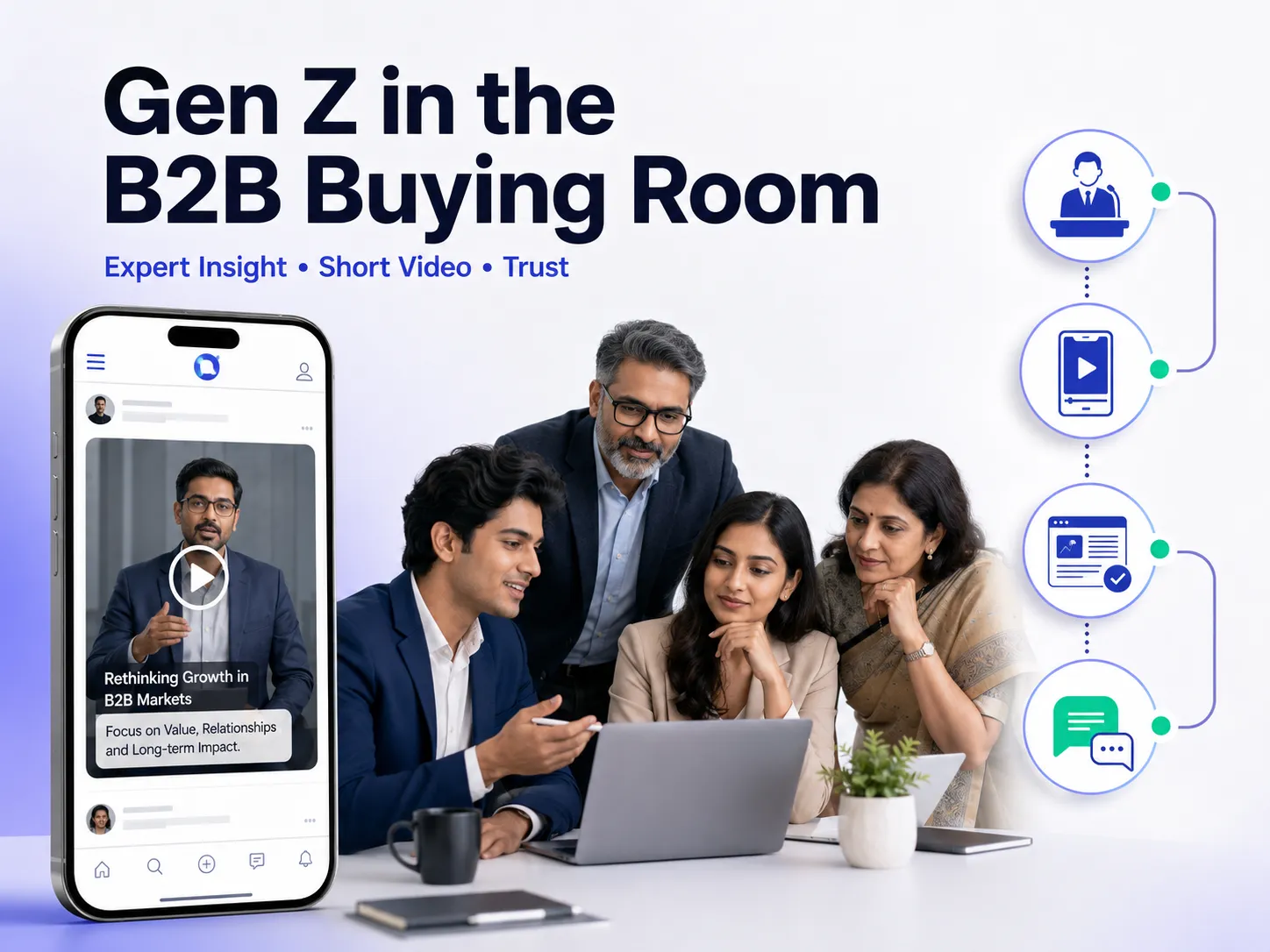
LinkedIn published new multi-country research on 2 September 2026 examining younger professionals, professional relationships and the growing importance marketers place on reaching Gen Z and Millennial business decision-makers.
India was included in the research, but LinkedIn did not release separate findings for Indian respondents. The published percentages must therefore be treated as multi-country results—not statistics describing every Indian Gen Z professional or business buyer.
One finding deserves particular attention from Indian B2B brands: 89% of surveyed B2B marketers agreed that future growth depends on influencing Gen Z and Millennial decision-makers. When asked about effective ways to reach Gen Z buyers, 49% selected short-form and immersive video, while 42% identified content from expert voices. LinkedIn’s September 2026 research
These figures do not mean that 49% of Gen Z buyers personally said they preferred short videos. They represent marketers’ views about effective engagement methods.
The practical lesson is also more nuanced than “post more videos.” Short video can attract initial attention, but expertise, evidence and a credible destination help transform that attention into business trust.
Key takeaways
- LinkedIn announced the research on 2 September 2026.
- India was among the 12 markets included.
- LinkedIn did not publish India-only percentages from the new survey.
- Younger professionals should not be treated only as job seekers or junior employees; they may research, recommend and influence business purchases.
- 89% of surveyed B2B marketers agreed that future growth depends on influencing Gen Z and Millennial decision-makers.
- 49% of marketers identified short-form and immersive video as effective for reaching Gen Z buyers.
- 42% identified content from expert voices.
- These are marketer responses, not direct Gen Z content-preference statistics.
- The announcement concerns research—not a new LinkedIn feature, advertising product or targeting option.
- Short video does not guarantee reach, enquiries or sales.
- Indian businesses need a connected system combining attention, expertise, proof and a clear next step.
What did LinkedIn’s September 2026 research examine?
LinkedIn commissioned Censuswide to conduct two multi-country surveys.
The professional survey included 18,050 full-time and part-time professionals aged 18 to 80. Responses were collected between 20 July and 11 August 2026.
The separate marketer survey included 6,196 B2B marketers at junior-manager level or above and ran from 21 July to 6 August 2026.
The participating markets were:
- India
- United Kingdom
- United States
- France
- Germany
- Italy
- Netherlands
- Singapore
- Australia
- Brazil
- United Arab Emirates
- Saudi Arabia
LinkedIn said each market included at least 150 respondents aged 18–29 and at least 200 qualifying senior decision-makers. However, it did not disclose the complete Indian sample or India-only results for the headline findings. LinkedIn’s research announcement and methodology
What has LinkedIn officially confirmed?
The research combined findings about professional confidence with findings about B2B marketing.
Among surveyed Gen Z professionals:
- 72% said they felt disconnected from people who could help their careers.
- 37% worried about bothering people.
- 37% feared being judged.
- 34% worried about sounding inauthentic.
- 53% were unsure how to begin building professional relationships.
- 52% did not know how to turn contacts into meaningful connections.
- 64% said nobody had clearly shown them how to build professional relationships.
- 27% said they had found their next opportunity through an online professional community.
In the separate B2B marketer survey:
- 89% agreed that future growth depends on influencing Gen Z and Millennial decision-makers.
- 49% identified short-form and immersive video as an effective way to reach Gen Z buyers.
- 42% selected content from expert voices.
These findings come from two different respondent groups. The professional-confidence statistics should not be presented as answers from B2B marketers, and the content-format findings should not be presented as direct responses from Gen Z buyers.
What remains uncertain?
The announcement does not tell us:
- The exact number of Indian respondents
- Whether Indian responses differed from the global findings
- Which Indian industries showed the strongest younger-buyer influence
- Whether small businesses responded differently from large enterprises
- Whether Mumbai, Bengaluru, Delhi or other cities produced different results
- Whether short video generated more sales than written content
- Which video length performed best
- Whether organic or paid videos produced the marketer responses
- How many purchases were controlled directly by Gen Z professionals
- Whether the marketers’ preferred formats produced measurable revenue
- Whether LinkedIn plans a related product or targeting launch
This was a research announcement. It did not launch a new video format, feature, application programme or advertising tool. No participation deadline, special eligibility requirement or paid-access condition was announced.
Are younger professionals really B2B decision-makers?
“Decision-maker” should not be interpreted as the person who signs every contract.
B2B purchases often involve several participants:
- A person who identifies the problem
- Someone who researches suppliers
- A user who evaluates the product
- A technical or operational reviewer
- A manager who creates the shortlist
- A finance or procurement team
- A senior person who gives final approval
A younger professional may influence the shortlist, evaluate a solution, recommend a vendor or reject an option before it reaches senior management.
LinkedIn’s earlier analysis of Millennials and Gen Z in B2B buying committees similarly argues that younger buyers are playing a larger role in business discovery and evaluation. LinkedIn’s younger B2B buyer analysis
The correct response is not to replace senior-buyer content with youth-focused trends. Indian businesses need content that works for different members of the buying group.
A practical Indian example
Consider a growing company selecting a WhatsApp Business API provider.
A younger marketing executive may:
- Discover potential providers on LinkedIn
- Watch a short product explanation
- Compare capabilities
- Check the company website
- Review a case study
- Present the preferred options internally
The founder or department head may approve the final purchase, but the younger employee’s research can still shape which providers are considered.
The same pattern can apply to website development, HR software, real-estate services, corporate training, business consulting and marketing agencies.
What do the video and expert-content findings actually mean?
The 49% and 42% findings should be read together.
Short video provides a concise way to introduce an idea. Expert-led content gives that idea authority and context.
A video may attract attention because it is easy to consume, but a recognisable expert can explain:
- Why a problem occurs
- How a business should evaluate its options
- What common mistakes to avoid
- Which questions buyers should ask
- What evidence supports a recommendation
- When a particular service may not be suitable
The strongest content is therefore not simply short. It is focused, useful and supported by credible knowledge.
What counts as expert-led content?
Expert-led content can feature:
- A founder explaining a customer problem
- An employee demonstrating a business process
- A specialist commenting on an industry change
- A customer describing an implementation experience
- A product expert answering a common buying question
- A team member explaining a mistake and what was learned
The word “expert” should not be used as an unsupported label. The person’s role, knowledge and experience should be clear from the content.
Why this matters to Indian B2B brands
LinkedIn’s new survey is global, but India’s inclusion makes the direction relevant to Indian marketers.
Earlier India-specific LinkedIn research, reported in November 2024, found that 66% of surveyed Indian B2B buyers said video influenced their purchasing decisions. It also reported that 83% of Indian B2B video consumers considered short-form video from industry experts a trusted source when making decisions. Exchange4media’s India coverage
Those figures came from an older and separate study. They should not be treated as part of LinkedIn’s September 2026 survey.
Together, the studies indicate a continuing strategic opportunity: Indian businesses can use video to make professional knowledge easier to discover, but expertise and trust remain central to the buying process.
LinkedIn’s January 2026 marketing analysis also reported that 78% of surveyed B2B marketers were using video, 56% planned to increase its use and 94% agreed that trust was critical to long-term B2B success. These findings came from another separate study. LinkedIn’s January 2026 video analysis
The Expert-to-Enquiry Content System
Vertex Social’s practical interpretation is that Indian B2B brands need a connected content system—not an isolated video-posting schedule.
1. Start with genuine expert insight
Select one specific question that a prospective customer frequently asks.
Examples include:
- What should a business check before hiring a website developer?
- When does a company need WhatsApp Business API?
- What causes poor-quality leads from Meta Ads?
- Which documents should a property buyer verify?
- How should a company compare recruitment partners?
- What should a school consider before purchasing music equipment?
Ask a founder, employee or specialist to answer the question in plain language.
Avoid beginning with a generic service promotion. Useful explanations provide a stronger reason to continue watching.
2. Convert one insight into a short video
The video should communicate one clear idea rather than compressing an entire sales presentation.
A practical structure is:
- Problem: Name the situation the buyer recognises.
- Insight: Explain what is commonly misunderstood.
- Example: Show how the issue appears in practice.
- Next step: Offer a relevant resource or action.
There is no universal video length guaranteed to perform best. The video should be as short as the explanation allows without removing the details needed for accuracy.
Use captions because professionals may encounter the video without sound. Keep the person, voice and explanation central; excessive transitions or decorative effects should not overpower the expertise.
3. Provide deeper proof
A short video rarely answers every question involved in a business purchase.
Give interested viewers somewhere to find:
- A detailed article
- A relevant service page
- A case study
- A customer example
- A portfolio project
- A comparison guide
- A product demonstration
- A clear company profile
This is where written content and a professional website remain important.
A video may begin the conversation. The website helps a potential buyer verify the company, understand the offer and decide whether to take the next step.