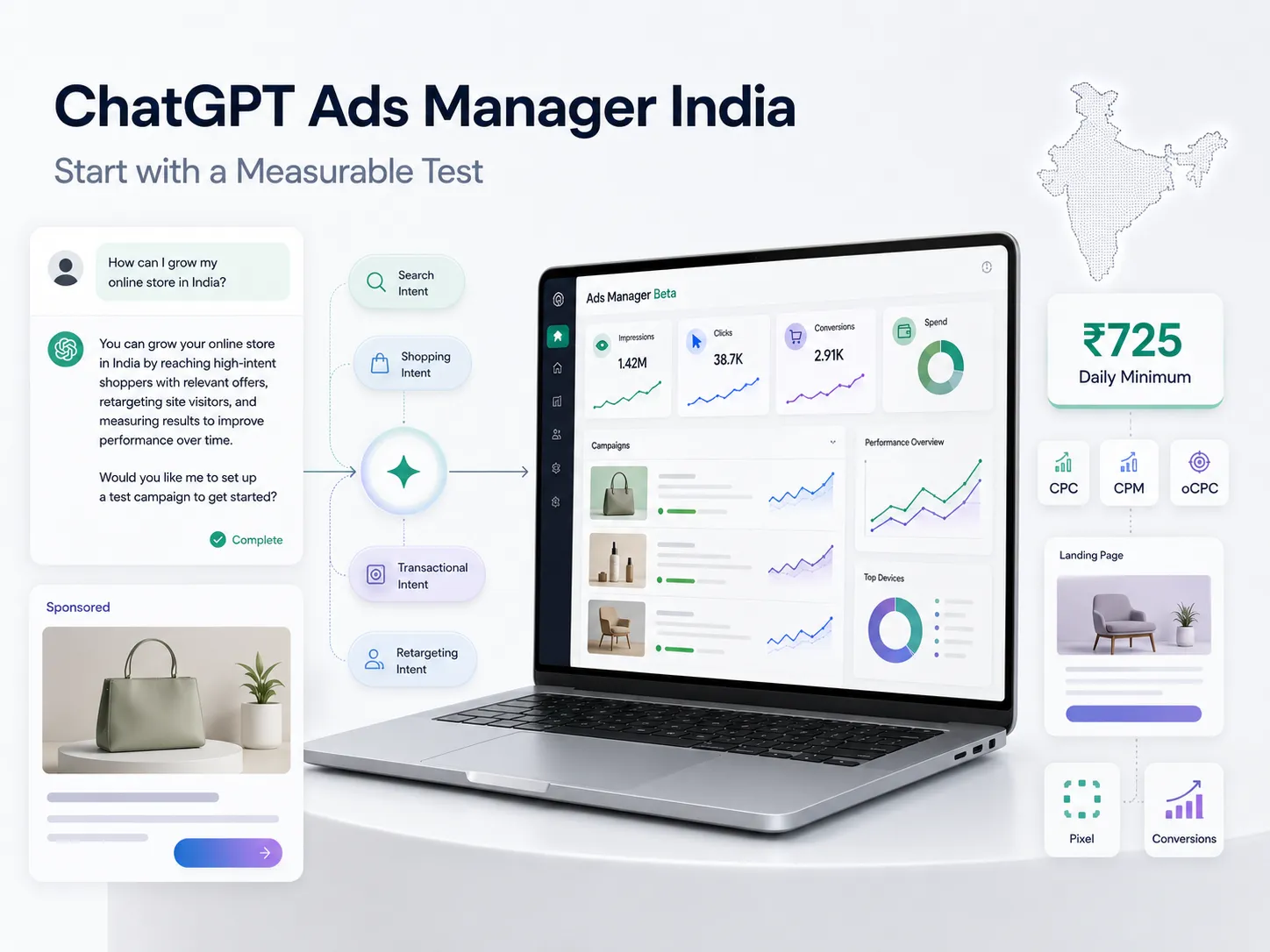
Indian businesses can now create and manage advertising campaigns that appear within ChatGPT through OpenAI Ads Manager Beta.
Although people commonly search for “ChatGPT Ads Manager”, the official distinction is straightforward: ChatGPT Ads is the advertising product, while OpenAI Ads Manager Beta is the platform advertisers use to build, launch and monitor campaigns.
OpenAI announced the wider international expansion on 31 August 2026, including direct Ads Manager access across India. Its current country-availability page now lists India as Available for self-service signup. OpenAI’s India expansion announcement and Ads Manager availability page
The platform’s official campaign documentation also confirms a minimum daily campaign budget of ₹725 for advertiser accounts billed in Indian rupees. This is a budget setting—not the price of one click, a guaranteed daily charge or a promise of leads. OpenAI’s campaign and minimum-spend guidance
For Indian businesses, this creates access to a new advertising environment built around research, comparison and decision-making conversations. It should still be treated as a beta test requiring a clear offer, credible landing page and reliable conversion tracking.
Key takeaways
- India is currently listed as available for direct Ads Manager signup.
- The advertiser platform is officially called OpenAI Ads Manager Beta.
- The advertising product is called ChatGPT Ads.
- Ads appear below ChatGPT responses and remain visually separate from them.
- Paying for an ad does not influence ChatGPT’s answer or organic recommendations.
- Advertisers cannot access users’ private conversations.
- The official minimum daily campaign budget for India is currently ₹725.
- ₹725 is not a fixed CPC, guaranteed daily spend or guaranteed campaign result.
- OpenAI currently supports CPM, CPC and conversion-optimised CPC campaign objectives.
- Context hints help describe relevant conversations, but they are not exact-match keywords.
- Free and Go users may see ads; Plus, Pro and business-plan accounts do not.
- Accounts, campaigns and advertisements remain subject to verification, review and advertising policies.
- Ads Manager remains a beta product, so its capabilities and interface may change.
What exactly has OpenAI launched in India?
OpenAI Ads Manager Beta is a self-service platform through which eligible businesses can create, launch, manage and measure ChatGPT advertising campaigns.
OpenAI’s current availability documentation lists India as available, meaning Indian advertisers can sign up directly rather than relying exclusively on a managed-sales or agency arrangement. Creating an account does not automatically guarantee approval: advertisers must complete verification, billing and account review before campaigns can deliver. OpenAI Ads Manager availability and account-setup guidance
OpenAI describes Ads Manager as a beta product that will continue evolving. It currently provides guided campaign creation, bulk uploads, campaign management, performance reporting and account-level controls. OpenAI Ads Manager Beta overview
This is not:
- A tool for placing advertisements across unrelated websites
- A payment method for influencing ChatGPT’s answers
- A way to purchase an organic mention from ChatGPT
- An SEO or answer-engine ranking service
- Access to users’ private conversations
- A guarantee that an approved ad will appear during a specific conversation
Where do ChatGPT ads appear?
OpenAI says ads can appear below the end of a ChatGPT response. They are labelled as sponsored and visually separated from the answer.
A standard ad may include:
- Advertiser name
- Brand favicon or logo
- Headline
- Description
- Landing-page link
- Image creative
The advertisement is a paid placement below the response. It is not inserted into the wording of ChatGPT’s answer and does not mean OpenAI endorses the advertiser. OpenAI’s guide to ads in ChatGPT
That distinction matters. A business can pay for eligible advertising placement, but it cannot pay to make ChatGPT describe the company as the best option or place it first in an ordinary answer.
Which ChatGPT users may see ads?
OpenAI says ads may appear to users on the Free and Go plans in eligible regions.
Ads are not shown to:
- Plus users
- Pro users
- Business-plan accounts
- Enterprise accounts
- Education accounts
- Accounts identified as belonging to people under 18
- Temporary Chats
OpenAI also excludes advertisements from appearing near sensitive or regulated conversations, including personal health, mental-health and political topics. Availability and user eligibility may continue changing as the test expands. OpenAI’s user advertising FAQ
Indian advertisers should therefore avoid treating the entire ChatGPT user base as addressable advertising inventory.
Can advertisers read ChatGPT conversations?
No.
OpenAI says advertisers do not receive users’ chats, chat histories, memories, names, email addresses, precise locations, IP addresses or sensitive information.
The advertising system may use the context and intent of the current conversation to determine relevance. When ad personalisation is enabled, selected signals from a user’s broader ChatGPT experience may also contribute to matching. Those signals remain within ChatGPT and are not handed to the advertiser as private conversation data.
Advertisers receive campaign reporting such as impressions, clicks, spend and other aggregated performance information. OpenAI’s privacy explanation for ChatGPT Ads
If a user directly messages an advertiser through an advertising feature, the advertiser can see the messages that the user intentionally sends to that business. That is different from accessing the user’s original private ChatGPT conversation.
How does ChatGPT decide which ad to show?
ChatGPT Ads uses contextual relevance and expected outcomes rather than relying only on a conventional keyword list.
OpenAI says its system may consider:
- The context and intent of the current conversation
- The advertiser’s landing page
- The ad headline and description
- Advertiser-supplied context hints
- Campaign targeting selections
- Selected broader ChatGPT signals when personalisation is enabled
- Advertiser bids
- Expected relevance and performance
What are context hints?
Context hints describe conversations, topics, needs or situations in which an advertisement may be relevant.
For example, a website-development company should not merely submit isolated terms such as:
- Website
- Web designer
- Business website
A more useful context description may explain that the service is intended for people researching how to create a professional website, replace an outdated business website, improve mobile usability or develop an online enquiry journey.
OpenAI is clear that context hints are not exact-match keywords. They guide matching but do not guarantee delivery during a particular conversation. OpenAI’s ChatGPT Ads basics
Can a context hint guarantee placement?
No.
Even when a conversation appears relevant, delivery can depend on eligibility, targeting, bids, ad quality, policy review, predicted outcomes and competing advertisements.
Businesses should therefore think in terms of customer problems and decision contexts rather than trying to copy a Google Search keyword sheet into Ads Manager.
How much do ChatGPT Ads cost in India?
OpenAI’s current campaign documentation lists the minimum daily campaign budget for India as ₹725. OpenAI’s Minimum Campaign Spend table
This figure needs careful interpretation.
The ₹725 amount is:
- The current minimum daily budget for an INR advertiser account
- A campaign budget setting
- Subject to future platform changes
It is not:
- The cost of one click
- An Indian average CPC
- A fixed CPM
- A guaranteed amount that will be spent every calendar day
- The total cost of a meaningful test
- A promise of impressions, traffic, enquiries or sales
OpenAI defines a daily budget as the average amount a campaign is intended to spend per day over a seven-day period. Its billing guidance says actual media spend can reach up to twice the selected daily budget on an individual day, while spend over the applicable seven-day period should not exceed seven times that daily budget, subject to applicable adjustments. OpenAI’s billing and payment guidance
Therefore, an advertiser choosing a ₹725 daily budget should not automatically assume that the platform will spend exactly ₹725 every day.
A campaign-total budget provides stricter control over maximum campaign spend, while a daily budget gives the system flexibility to vary delivery within its documented limits.
Which campaign objectives and payment models are available?
OpenAI’s latest campaign documentation lists three current objective types:
| Objective type | How the advertiser pays | Intended use |
|---|---|---|
| CPM | Per 1,000 impressions | Visibility, reach and awareness |
| CPC | Per valid click | Website traffic and engagement |
| Conversion-optimised CPC, or oCPC | Per valid click | Optimising clicks towards a configured conversion event |
With oCPC, the advertiser still pays for valid clicks rather than directly paying for each conversion. Conversion tracking must be configured so that the platform can optimise towards the desired action. OpenAI’s campaign-objective documentation
OpenAI’s general advertiser guidance recommends considering a starting maximum CPC bid of US$3–$5 per click. This is platform guidance for setting an initial maximum bid—not an Indian average CPC, minimum bid or guaranteed clearing price. OpenAI’s bidding guidance
The platform uses a relevance-weighted, second-price auction. This means the highest bid does not operate in isolation; relevance and expected outcomes can also influence selection.
Businesses should not convert the US$3–$5 guidance into a supposed fixed Indian cost-per-click benchmark.
How is a ChatGPT Ads campaign structured?
Ads Manager Beta uses three main levels.
1. Campaign
The campaign defines the broader advertising setup, including:
- Objective
- Budget
- Start and end dates
- Country targeting
- Platform targeting where available
- Conversion event for applicable campaigns
- Optional audience inclusions or exclusions where supported
2. Ad group
An ad group organises advertisements around a particular theme, customer need or intent area.
At this level, advertisers can define context hints and set relevant bids. Separate ad groups can test different problems, use cases or value propositions.
3. Ad
The ad is the creative that appears below a ChatGPT response.
It can include:
- Title
- Description
- Image
- Advertiser identity
- Landing page
Every advertisement must be submitted for review. Completing account setup or creating a campaign does not bypass policy review. OpenAI’s campaign quickstart
How can an Indian business create an Ads Manager account?
Step 1: Visit OpenAI Ads Manager
Go to ads.openai.com and sign in using an OpenAI account connected to a work email, or create an account during signup.
Step 2: Enter accurate business information
OpenAI currently requests details including:
- Business name
- Website
- Logo
- Industry
- Advertiser country
- Currency
- Time zone
- Legal and billing information
Country, billing currency and time zone may not be editable after account creation. Businesses should therefore confirm these details carefully before submitting the account.
Step 3: Complete verification
Advertisers must complete the required identity or business-verification process. OpenAI also reviews whether the advertiser’s products or services are eligible under its advertising policies.
Completing verification does not guarantee instant platform approval. OpenAI says account applications are reviewed through a rolling queue and may take time. OpenAI’s account-setup process
Step 4: Configure billing
Advertisers need to create a billing profile and add an accepted payment method before campaigns can deliver.
The business should confirm:
- Legal billing name
- Billing address
- Invoice email
- Billing currency
- Available payment method
- Tax treatment shown inside the live account
OpenAI currently uses post-pay billing for ChatGPT Ads, with charges applied after media has been delivered and an assigned payment threshold is reached. OpenAI billing and payment
Step 5: Invite team members
The account owner can invite colleagues who need access to campaign management, billing or reporting.
Agencies managing multiple advertisers should create a separate advertiser account for each client rather than combining unrelated businesses into one account.
Step 6: Create the campaign
Choose the campaign objective, budget, dates and supported targeting options.
OpenAI officially supports country targeting. Additional state, city or postal-code options vary by market and should be checked through the live location picker. Indian advertisers should not assume that every city or PIN code is already available.
Step 7: Create ad groups and context hints
Organise each ad group around one clear customer problem or decision context.
For example, an education business could separate:
- People comparing professional certification courses
- Working professionals researching career upgrades
- Students looking for flexible online learning
- Businesses evaluating employee-training solutions
These are strategic examples, not guaranteed targeting categories.
Step 8: Build the ad and destination page
Prepare the title, description, image and landing page.
The creative and destination should communicate the same offer. An advertisement for a specific service should not lead to a generic homepage that makes the user search for the promised information.
Step 9: Submit the campaign for review
Campaigns must complete review before serving. Ads may be rejected because of prohibited claims, restricted categories, inconsistent landing pages or incomplete account requirements.
Step 10: Monitor delivery and results
After approval, check whether the campaign is serving and review its early performance before increasing the budget.
Does a business need a website?
OpenAI’s account setup asks for an advertiser website, and ChatGPT advertisements contain a landing-page destination.
A credible website or landing page is therefore a core campaign requirement, not an optional finishing touch.
Before testing ChatGPT Ads, the destination page should provide:
- A clear headline
- A specific product or service
- Accurate pricing or enquiry expectations
- Mobile-friendly navigation
- Visible business identity
- Relevant trust signals
- Clear contact or purchase action
- Privacy information
- Necessary disclaimers
- Fast loading
- Consistent messaging from ad to page
A weak destination can waste traffic even if the advertisement receives relevant clicks. Businesses reviewing a new advertising channel should therefore assess their conversion-focused website development requirements before increasing media spend.
How can campaign performance be measured?
Ads Manager Beta currently reports:
- Impressions
- Clicks
- Spend
- Click-through rate
- Average CPC
- Average CPM
- Conversions when measurement is configured
Reports can be viewed through campaign, ad-group and ad tables, charts and downloadable CSV files. OpenAI’s measurement guide
OpenAI supports conversion measurement using:
- JavaScript Pixel
- Conversions API
- Supported measurement partners
- Landing-page tracking parameters
- Static or dynamic UTM-style parameters
Advertisers should connect Ads Manager data with their existing analytics, CRM, website forms, telephone enquiries and WhatsApp lead records.
Metrics that matter beyond clicks
A local business should not call a campaign successful simply because it received traffic.
Depending on the goal, track:
- Qualified enquiries
- Booked consultations
- Product purchases
- Completed registrations
- Cost per qualified lead
- Conversion rate
- Revenue attributed to advertising
- Lead-to-sale rate
- Duplicate and low-quality leads
- Enquiries from supported service areas
- Return on advertising spend where reliable revenue attribution exists
For a real-estate campaign, for example, ten enquiries without the required budget or preferred location may be less useful than three properly qualified prospects.
ChatGPT Ads versus Google Search and Meta Ads
| Area | ChatGPT Ads | Google Search Ads | Meta Ads |
|---|---|---|---|
| Primary environment | AI conversations | Search results | Social feeds and connected placements |
| Main intent signal | Conversation context and current intent | Search query and related signals | Audience, behaviour, content and platform signals |
| Advertiser guidance | Context hints and campaign targeting | Keywords and other campaign signals | Audiences, creative and optimisation signals |
| Current buying approaches | CPM, CPC and oCPC | Multiple models | Multiple models |
| Typical user mindset | Exploring, comparing or deciding | Actively searching | Browsing, discovering or engaging |
| Platform maturity | New and in beta | Mature | Mature |
| India self-service | Available | Available | Available |
This is a high-level comparison. No platform is automatically superior.
Google Search may remain stronger when someone expresses a short, direct query. Meta may be useful for generating visual discovery and demand. ChatGPT Ads may be relevant when the user is explaining a detailed need, comparing options or working through a decision.
The appropriate channel depends on the business, audience, offer, available creative, customer journey and measurement quality.
Which Indian businesses may be suitable for an initial test?
ChatGPT Ads may be worth evaluating when customers commonly research, compare or seek explanations before buying.
Possible categories include:
- Software and business tools
- Consumer electronics
- Education and professional courses
- Travel and experiences
- Home improvement
- Permitted local services
- E-commerce products requiring comparison
- Business and professional services
- Eligible real-estate information and services
- Other categories permitted under OpenAI’s current policies
This is a suitability hypothesis—not a performance forecast.
Regulated industries must review OpenAI’s current advertising rules carefully. OpenAI presently applies additional restrictions to areas such as financial services, healthcare, legal services, political advertising, gambling, alcohol and other sensitive categories. Eligibility can differ by country and may require additional review. OpenAI Ads Policies
The Vertex Social ChatGPT Ads Readiness Check
Before committing a larger budget, businesses can use this six-part readiness framework.
1. Research-fit check
Ask whether potential customers normally:
- Compare several options
- Explain their requirements in detail
- Research features or prices
- Need education before buying
- Consider trade-offs
- Look for a specialised provider
If customers usually buy impulsively without research, another advertising environment may be more suitable.
2. Offer-clarity check
Confirm that the campaign has:
- One clear offer
- A defined customer problem
- A credible value proposition
- Accurate claims
- A realistic next step
- A suitable destination page
An advertisement should not promise a specific result that the landing page cannot support.
3. Conversation-context check
Write context hints around the decision being made rather than copying isolated search keywords.
Describe:
- The problem
- The intended customer
- The decision stage
- Relevant use cases
- Important exclusions
- The outcome the customer is seeking
Context hints guide matching but do not guarantee delivery.
4. Measurement check
Prepare:
- A conversion event
- OpenAI Pixel or Conversions API where appropriate
- Analytics
- URL tracking parameters
- Website-form attribution
- Phone and WhatsApp tracking
- Lead-quality reporting
- A cost-per-qualified-lead target
Vertex Social’s AI and marketing automation support can help connect campaign enquiries with a more organised lead journey.
5. Test-budget check
Define:
- Test period
- Maximum approved spend
- Campaign objective
- Bid
- Target geography
- Conversion goal
- Pause conditions
- Review schedule
- Lead-quality requirement
Treat ₹725 as the current minimum daily budget—not proof that one day of advertising provides a meaningful test.
6. Policy-and-trust check
Verify:
- Advertiser identity
- Product eligibility
- Accuracy of claims
- Creative compliance
- Landing-page consistency
- Required disclosures
- Customer privacy
- Industry-specific restrictions
A well-structured performance advertising and campaign management process should cover these checks before scaling expenditure.
A practical controlled-test plan
An Indian SME testing ChatGPT Ads should avoid moving its complete Google or Meta budget immediately.
A safer initial approach is:
- Choose one service, product or offer.
- Select one measurable campaign objective.
- Create separate ad groups for clearly different customer intentions.
- Prepare at least two meaningful creative variations.
- Send traffic to a focused landing page.
- Configure conversion and lead-quality tracking.
- Set an approved budget and test period.
- Review search-context fit, clicks and conversions.
- Compare qualified outcomes—not only impressions.
- Scale, revise or stop based on evidence.
Businesses should evaluate ChatGPT Ads as part of an integrated channel strategy rather than assuming it will replace established advertising platforms.
What Indian businesses should avoid
Do not confuse advertising with organic ChatGPT visibility
Paying for a ChatGPT ad does not improve the likelihood of being mentioned in ChatGPT’s normal answer.
Do not treat context hints as exact-match keywords
They help describe relevant conversations but do not reserve a specific query or guarantee placement.
Do not describe ₹725 as the price of a click
It is the current minimum daily campaign budget for India.
Do not assume the platform spends exactly ₹725 every day
Daily budgets operate as averages over a seven-day period and can fluctuate within OpenAI’s documented limits.
Do not use the US$3–$5 bidding guidance as an Indian CPC benchmark
It is general initial maximum-bid guidance, not an Indian market average.
Do not promise early-mover results
A new channel can still have weak delivery, expensive clicks, low conversion rates or unsuitable traffic.
Do not advertise without conversion tracking
Clicks alone cannot confirm whether a campaign produced meaningful business results.
Do not copy a Meta or Google campaign unchanged
ChatGPT’s conversational environment requires context-aware messaging and a suitable landing-page experience.
Do not assume every industry is eligible
Advertiser accounts, products, creative and destinations remain subject to policy and review.
Do not claim that every ChatGPT user will see the campaign
Only eligible users in supported plans and locations may receive advertisements.
Do not claim access to private conversations
Advertisers do not receive users’ private chat histories or personal conversation data.
What remains uncertain?
Despite the confirmed India launch, several market-level details are not publicly established:
- India-specific average CPC or CPM
- Average click-through rate
- Industry conversion benchmarks
- Average return on advertising spend
- Number of active Indian advertisers
- Auction competition by Indian city or industry
- Expected lead volume from ₹725 per day
- Typical Indian account-approval time
- Reach estimates for specific Indian cities
- Final tax treatment for every account configuration
- How quickly additional campaign features will reach every advertiser
The platform is also in beta, so objectives, targeting, measurement, formats, policies and budget requirements can change.
Businesses should check the live Ads Manager interface and current OpenAI documentation before launching or changing a campaign.
Frequently asked questions
Is ChatGPT Ads Manager available in India?
Yes. OpenAI’s current Ads Manager availability page lists India as available for self-service access.
What is the platform’s official name?
The advertiser platform is called OpenAI Ads Manager Beta. The advertising product is ChatGPT Ads.
What is the minimum daily budget in India?
OpenAI’s current campaign documentation lists a minimum daily budget of ₹725 for India.
Is ₹725 charged every day?
Not necessarily. A daily budget is an average delivery target over seven days. Actual daily spend may fluctuate within OpenAI’s documented limits.
Is ₹725 the cost of one click?
No. It is the minimum daily campaign budget, not a CPC.
How are ChatGPT Ads purchased?
OpenAI currently documents CPM, CPC and conversion-optimised CPC objectives.
Does ChatGPT advertising use keywords?
Advertisers can mention topics or keywords within context hints, but those hints are not exact-match keywords and do not guarantee placement.
Can advertisers read user conversations?
No. OpenAI says advertisers do not receive private chats, chat histories, memories or personal details.
Can an advertisement influence ChatGPT’s answer?
No. OpenAI says advertisements operate separately and do not influence answers.
Which plans may show ads?
Ads may appear to eligible Free and Go users. Plus, Pro, Business, Enterprise and Education accounts do not have ads under the current policy.
Can a local business target an Indian city?
Location options vary by market. Advertisers should search for the required city or area in the live campaign location picker before claiming that it is available.
Does creating an account guarantee approval?
No. Advertisers must complete verification and account review, and campaigns are separately reviewed for policy compliance.
Are results guaranteed?
No. The platform does not guarantee impressions, clicks, conversions, enquiries, sales or return on advertising spend.
Should Indian businesses test ChatGPT Ads now?
Businesses with research-heavy customer journeys may have a valid reason to explore the platform while it is still new.
The right question is not whether ChatGPT Ads is automatically better than Google or Meta. It is whether the channel can reach a relevant decision-making audience and produce measurable business outcomes at an acceptable cost.
A controlled test should begin with one clear offer, compliant creative, a focused landing page and reliable conversion tracking. Vertex Social can help businesses evaluate the channel alongside their existing advertising, website and enquiry journey without treating early access as guaranteed growth.